Jun
22
Warp Space, Yes; Warp Drive, Not Yet
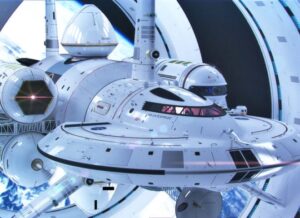
As anyone slightly informed about physics knows, matter within the spacetime continuum cannot move at or beyond the speed of light. (It’s a lot more complicated than that, but let’s not get into the weeds…) As anyone slightly informed about Star Trek knows, the way around this is to generate a warp field/bubble with a “warp drive” and travel through “warp space”. The “warp” comes from the idea of bending/twisting spacetime around an object, like a starship, such that it moves across distances faster than the speed of light. Anything within the “warp field/bubble” remains in a localized region of regular spacetime and so does not violate any physical laws. Or, as Tibi Puiu described it in his article at ZME Science,
“A spacecraft equipped with a warp drive would create a bubble of flat spacetime around itself, contracting space in front of it and expanding space behind it, effectively moving the ship through space at superluminal (faster-than-light) speeds.”
In effect, we get motion without movement. Or, at least, without acceleration through space. Very cool. Except that warp drives are only theoretical at this point and pose huge problems that still need solutions.
One possible method is called the Alcubierre Drive (or Alcubierre metric) — named after the guy who proposed it, Mexican theoretical physicist Miguel Alcubierre. As per Wikipedia,
“The proposed mechanism of the Alcubierre drive implies a negative energy density and therefore requires exotic matter or manipulation of dark energy. If exotic matter with the correct properties does not exist, then the drive cannot be constructed.”
Even if it did exist, “[u]ntil we can figure a way to scoop up a Sun-sized mass of the stuff, this kind of drive just isn’t possible.”
Back in early 2021, researchers from the independent research group Applied Physics published the results of a new study they did which came up with a workaround. In brief, rather than all of that negative energy (which might not even be available, let alone harnessable), a hugely powerful gravitational field would do the trick.
“The gravity would do the heavy lifting of bending space-time so that the passage of time inside and outside the warp drive machine would be significantly different.”
(Note: I think there was an editing error, and it should say, “would not be significantly different.”)
Don’t get too excited, yet. As expected, this method seems to have just as massive a problem.
“[T]he amount of mass required to produce a noticeable gravitational effect on space-time would be at least planet-sized, and there are still plenty of questions to answer.”
The ScienceAlert article assures its readers,
“Even though the reality of travelling to distant stars and planets is still a long way off, the new study is the latest addition to a growing body of research that suggests that the principles of warp drives are sound in scientific terms.”

This leads directly to another new study published just last year (2024), in which the researchers propose another approach that avoids most of the problems associated with the Alcubierre model.
“This study changes the conversation about warp drives. By demonstrating a first-of-its-kind model, we’ve shown that warp drives might not be relegated to science fiction.” — lead author Dr. Jared Fuchs, a physicist at the University of Alabama, Huntsville
The following summary by Puiu of this new model is sufficient for a layman (like myself and maybe you) to get the gist of it without being inundated by scientific details:
“The researchers used a new computational tool, Warp Factory, to explore and design the spacetime metrics required for the warp drive. Their design starts with a Minkowski background (flat spacetime with no gravity or curvature) and adds a stable matter shell (a layer of regular, non-exotic matter arranged in a specific way around the spaceship) with a carefully distributed shift vector (a mathematical device used in the description of spacetime that dictates how spacetime is being ‘shifted’ or modified around the spacecraft).
Together, this framework enables the warp bubble necessary for the spacetime modification. This bubble encloses the so-called ‘passenger region,’ which is free from local spacetime curvature, allowing for geodesic motion without local acceleration. Essentially, it creates a shortcut through spacetime. Inside this bubble, spacetime is curved in a way that allows the spacecraft to move from one point to another faster than light would in normal (flat) spacetime, without the spacecraft itself having to travel at such speeds locally.
Unlike previous models, this new model adheres to all energy conditions by incorporating a regular matter shell with a positive ADM (Arnowitt-Deser-Misner) mass. This approach ensures the physical viability of the warp drive by using only known and theoretically feasible materials and mechanisms. The authors emphasize the importance of the shift vector distribution in achieving these conditions, differentiating their model from others that rely heavily on negative energy densities or superluminal speeds.
The practicality of this warp drive in real-world applications remains speculative. It faces monumental engineering and technological challenges. The theoretical model, while robust within the confines of general relativity and classical physics, relies on a highly sophisticated and untested arrangement of matter and energy distributions. Achieving this on a practical scale — not to mention the enormous energy requirements and the creation of a stable warp bubble — remains far beyond our current technological ability.”
Over at Ars Technica, Paul Sutter spells out a couple of disappointing facts about this new approach that are not clear in the one at ZME Science.

“There is no such thing as a free lunch, however, and the physicality of this warp drive does come with a major caveat: the vessel and passengers can never travel faster than light. Also disappointing: the fact that the researchers behind the new work don’t seem to bother with figuring out what configurations of matter would allow the warping to happen.
On one hand, that’s a gigantic letdown. We already have plenty of methods for traveling slower than light (rockets, walking, etc.), so adding one more to the list isn’t all that exciting. Plus, even if we wanted to build this warp drive, the gulf between this hyper-theoretical work and an actual, physical propulsion mechanism is the same as the difference between writing down Newton’s laws and building a Falcon 9.
But that doesn’t mean this new development isn’t interesting…. Exploring how a warp drive might (not) work, and under what conditions and restrictions, is a step in [the right] direction. For years physicists thought that the energy conditions outlawed all kinds of warp drives, yet the new research shows a possible way around that. What comes next will be a win no matter what.”
And the march of progress continues on…