Jun
29
What Happened to the Lost State of Franklin?
“How committed were Americans to the basic American Revolution principles of self-determination?” — Kevin Barksdale, history professor at Marshall University and author of The Lost State of Franklin: America’s First Secession
With our upcoming celebration of American Independence Day this week, I thought a topic related to this might be appropriate. I then remembered coming across this fact a few years ago and decided to finally look into it….
I don’t recall ever hearing about the State of Franklin back in middle school or high school. But, then, it would probably be considered a mere footnote and an unnecessary distraction from more significant people and events that need to be taught during the school year. And that’s OK, ‘cuz we adults with a little time on our hands always appreciate a bit of historical trivia.
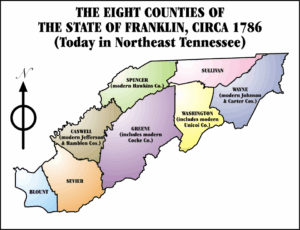
In the early days of the United States of America, a few counties in western North Carolina were “isolated from the rest of North Carolina and their governing representatives, separated by the formidable Southern Appalachian mountain range.” The residents felt marginalized, disenfranchised, and based on recent events, had reason to believe the government might sell their land to a foreign power to help pay off the Union’s war debts. North Carolina did in fact offer to cede the district to the federal government, but Congress took too long in deciding whether or not it was a wise move. A newly elected North Carolina Legislature re-evaluated the situation and rescinded the offer of cession in Nov. 1784, reasserting its claims. By this time, however, delegates from the counties of Washington, Sullivan, Spencer, and Greene had already met in Aug. 1784 and declared their independence and formation of a new, sovereign State.
“[The state’s] boundaries were nebulous and even the name was not agreed upon unanimously. One draft of the state constitution referred to the state as ‘Frankland’ – meaning free land or land of the free. ‘Franklin’ made it to the final version of the constitution, in honor of Benjamin Franklin.”
War hero John Sevier was elected governor of the State of Franklin. The state capital was Jonesborough — at least, until it moved to Greenville in Dec. 1785.
“Despite the Franklinites’ self-determination, their boundaries were never respected by the neighboring state from which they separated. The North Carolina government ignored Franklin’s secession and set up courthouses in its territory, leading to both states claiming the same parcel of land. This pocket of Appalachia was taxed by two state governments, two court systems enforced two sets of laws, and two state militaries marched on the same ground.”
Things escalated and Sevier’s property was seized. There was a drawn-out battle between 100 Franklinites and North Carolinian forces led by Sheriff John Pugh and Col. John Tipton. There were tensions and skirmishes with the local Cherokees over land agreements, especially when the newly-signed, federal Hope Treaty conflicted. Then, of course, the Confederation Congress denied Franklin’s plea to be recognized as an independent state, garnering less than the two-thirds majority required by the Articles of Confederation. One factor that probably played a part in this decision was a fear that the idea of smaller-scale self-determination would spread among more regions, leading to balkanization that could undermine the cohesion of the fledgling nation.
“Appalachia becomes a testing ground immediately after the revolution for the principles of the revolution. The chaos surrounding Franklin becomes a major player in shaping how the frontier in the Western territories will be integrated into the United States.” — Dr. Kevin Barksdale
It didn’t help that there were bitter divisions within Franklin itself. Franklin’s leadership even sought an alliance with Spain in hopes of getting rights to the Mississippi River and land grants that the American government would not give them, but that didn’t work out for a number of reasons.
The answer to Barksdale’s question at the top of this post is (as per Madelyn Brown): “Not committed enough to allow Franklin its self-determined statehood.” The answer to the question in the title of this post is: “After 4+ years of fighting for their right to be the 14th sovereign state of the Union, the people of Franklin lost their bid and, as they had feared, their land.”
In 1788, the North Carolina Assembly had Gov. Sevier arrested for treason and marched him off for trial in Morganton, NC. But, he never went to trial, because his old war-buddy the county sheriff released him. They didn’t bother re-arresting Sevier, but his arrest marked the beginning of the end for the State of Franklin, with the then-8 counties of Franklin — roughly 6400 sq. mi. — soon rejoining North Carolina. (The area was indeed ceded to the federal government in 1790 and became part of the newly-formed Southwest Territory.)
North Carolinians didn’t hold a grudge against the separatist war hero for too long, though. After taking an oath of allegiance to North Carolina, Sevier was pardoned by N.C. Governor Alexander Martin. He became a North Carolina state senator, then was appointed brigadier general of the Southwest Territory’s militia. Sevier went on to serve briefly as a U.S. Representative for North Carolina. He was later elected Tennessee’s first governor when it was formed (out of the Southwest Territory) and admitted into the Union in 1796 as the 16th state. Sevier was also elected as Tennessee’s third governor a couple years after that (1803), which he followed up with a stint as a U.S. Representative for Tennessee.
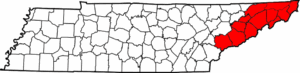
The Northeast portion of the State of Tennessee consists of the now-12 counties that once made up the State of Franklin. (See pic.)