Oct
12
Revelations from the Russia Hoax Documents
Definition of “The Russian Collusion Hoax”:
“The widespread and ultimately unfounded narrative that Donald Trump and his 2016 presidential campaign conspired with Russia to influence the outcome of the election…. The claims originated from a dossier compiled by ex-British intelligence officer Christopher Steele, which was indirectly funded by Hillary Clinton’s campaign and the Democratic National Committee (DNC). This document spurred an investigation by former FBI Director Robert Mueller, costing millions and lasting nearly two years, with no criminal conspiracy ultimately found.” (H/T americandebunk.com)
This week’s educational post is brought to you primarily thanks to the work of political commentator and columnist Mollie Hemingway. Hemingway is also editor-in-chief at The Federalist, a senior journalism fellow at Hillsdale College, and the author of such books as Justice on Trial and Rigged. The folks at Hillsdale College printed her recent article, “The Significance of the Recently Released Russia Hoax Documents”, in the Sept. 2025 issue of Imprimis. I have excerpted some important sections of that article below…
— — —

Six months into Trump’s second term, CIA Director John Ratcliffe and Director of National Intelligence Tulsi Gabbard have declassified and released long-suppressed documents detailing how President Obama and his spy chiefs laundered the Steele dossier and other falsehoods in an attempt to destroy Trump’s first presidency. The response from Democrats, the media, and many establishment Republicans has been to say that these suppressed documents contain nothing new or significant. Not true.
The Russia collusion hoax was anchored to two central claims: first, that Trump was a compromised agent of Russia, and second, that Russia interfered in the 2016 election to help Trump. The first claim was completely debunked after years of investigation. It is on the second and far more plausible claim — which was just as key to the hoax — that the newly released documents shed new light. And the revelations are shocking.
The documents show that in early December 2016, the intelligence community planned to publish a top secret presidential daily brief holding that “Russian and criminal actors did not impact recent US election results by conducting malicious cyber activities against election infrastructure.” Once published, this brief would have been read by Obama and his top officials, as well as President-Elect Trump and his designated National Security Advisor, Lt. General Michael Flynn. But the day before publication, the FBI — which had co-authored the brief — announced that it was pulling its support for the brief and would be drafting a dissent. The Office of the Director of National Intelligence announced that the brief would be held for the following week.
In the end, the brief was never published. Instead, Obama ordered his top spy chiefs to put together an Intelligence Community Assessment — known as an ICA — on “Russia election meddling.” The chiefs were directed to look at how Moscow sought to influence the 2016 election — including with hacking, leaks, cyber activity against voting systems, and “fake news” — and to answer the questions, “Why did Moscow direct these activities?” and “What have the Russians hoped to accomplish?” …
One document Ratcliffe released is a “tradecraft review” of the January 2017 ICA. Conducted by career officials at the CIA, the review found that the dishonest leaks by the Obama administration in December 2016 created an “anchoring bias” that polluted the entire document. The review also expressed concern about the ICA’s frantic production timeline; the refusal to allow analysts reviewing the document to see the intelligence its conclusions were based on; and the over-involvement of [then-FBI Director James] Comey, [CIA Director John] Brennan, and [Director of National Intelligence James] Clapper. It found that the assessment gave a “higher confidence level than was justified” to the claim that Russia preferred Trump and that it was tainted by a “potential political motive.”
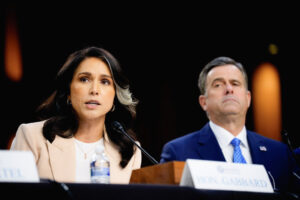
Gabbard released an even more explosive report. Authored in 2017 and 2018 by the House Permanent Select Committee on Intelligence chaired by Rep. Devin Nunes, it had been hidden in a top secret vault for seven years. It conclusively debunked the ICA’s “key judgement” about Putin’s preference for Trump, excoriated the ICA for using the preposterous Steele dossier as a basis for its claims, and detailed how the views of career intelligence officials were overruled and dismissed….
Brennan hadn’t allowed some of the information to go through normal vetting procedures when it was collected. And he “personally directed that two of the most important reports not be formally disseminated when he first learned of them,” supposedly because they were so sensitive — a questionable explanation given that the CIA has a special reporting channel for sensitive reports that are restricted to the president and other named individuals.
The only classified information cited in the ICA for the claim that Putin “aspired to help Trump’s chances of victory” was a fragment of a sentence that came from someone who did not personally know Putin. The fragment, consisting of the words, “whose victory Putin was counting on,” had been collected prior to the July 2016 Republican National Convention. So who could even know to which victory it referred? Furthermore, it is not known whether the fragment reflected the sub-source’s opinion of Putin’s thinking, Putin’s actual statements to his sub-source, or the views of someone else reflecting on Putin’s thinking to the sub-source. Its meaning was so unclear that “five people read it five ways,” according to the report.
For these reasons, experienced CIA officers initially omitted the fragment from the ICA. But Brennan ordered that it be included….
The ICA then claimed that Putin’s inner circle “strongly preferred Republican over Democratic candidates because they judged that Republicans had historically been less focused on democracy and human rights.” The phrase “strongly preferred Republican” never appeared in the raw intelligence report and the ultimate source for the claim is unknown. What’s more, the claim that Republicans cared less about democracy and human rights in Russia was implausible. The Select Committee report noted that President Reagan was famous for his “Mr. Gorbachev, tear down this wall” speech, but a myriad of other examples could be cited.
The ICA claimed that the “clear preference” report was corroborated by liaison, diplomatic, and press reporting, when in fact none of that was true. The liaison reporting was from 2014 and “didn’t mention Trump at all.” The diplomatic report was a post-election overview from the U.S. ambassador noting that a Russian pundit said Trump and Putin should “work together like businessmen,” hardly corroboration for the claim that Putin’s inner circle preferred Republicans. Indeed, that same ambassador’s note quoted a Russian foreign minister saying that “we do not feel any euphoria” about Trump’s win.

The ICA also omitted intelligence that Putin was telling people he “did not care who won the election,” that he had “outlined the weaknesses of both major candidates,” and that Russia was “strategically placed to outmaneuver either [candidate].” If anything, Russia was preparing for Clinton’s victory and felt she was more predictable. The Kremlin worried that Trump officials would “likely adhere to conservative anti-Russian positions.” Putin “took exception” to a “favorable view” of Trump and said there was “no basis for enthusiasm” for Trump….
The documents released by Ratcliffe and Gabbard show that career officers were pleading with their bosses not to assert, falsely, that Russia preferred Trump and not to include the Steele dossier in any way, shape, or form. One wrote: “Based solely on what we DO know now, my bottom line is this — unless FBI is prepared to provide much better sourcing — I believe this should NOT be included in the paper.” Noting that the document had not been formally issued as an FBI product, this same official characterized it as suffering from “POOR SOURCE TRADECRAFT,” as having “extremely sketchy” sourcing, and as failing to “meet normal [intelligence community] standards.”
Career senior intelligence officials worried about the dossier’s author being funded by an anti-Trump entity, even though they didn’t yet know that the funding came from the Clinton campaign. They also worried about the lack of transparency regarding the dossier’s sub-sources — a concern validated weeks later when the FBI finally got around to interviewing primary sub-source Igor Danchenko, a Russian national the FBI had suspected of being a spy, and determined that the salacious allegations in the dossier lacked any credibility. Despite this, the FBI defended the use of the dossier for years and hid Danchenko’s identity from Congress by hiring him as a confidential informant — a ruse allowing them to claim that revealing his identity would endanger ongoing investigations….
— — —
As Hemingway also reports, three days before Sen. Chuck Schumer was briefed on the Steele dossier in Jan. 2017, he warned President-Elect Trump that taking on the intelligence community — starting with criticizing the FBI and CIA — was a “really dumb” idea. To paraphrase Hemingway’s final comments, I’ll bet James Comey, John Brennan, and James Clapper (and maybe Schumer) are the ones with regrets on that front now. Unless, of course, they have no shame and continue to double-down on their previous lies and behavior.
For more information and analysis, you should read Hemingway’s full article.