Oct
26
Reason and the Sufficiency of Scripture, part 2 of 2
“Reason must be used to rightly interpret the Bible. We discern the meaning of the Bible not through mystical experience but through extensive thought and contemplation.” — Terry L. Johnson, Presbyterian pastor and author
This week, we continue our look at the idea of the sufficiency of Scripture in Christian theology and the role of reason in understanding what God communicates through Scripture. Specifically, the citation below comes from the book The Case for Traditional Protestantism by Terry L. Johnson, and it directly follows from what was cited in Part 1.
— — —
Recently both David F. Coffin and T. David Gordon have written brief but suggestive articles on the “insufficiency” of Scripture in order to underscore what is really meant by “sufficiency”. [Keith A.] Mathison makes the obvious point about Scripture: “It cannot read itself. It cannot preach itself. It cannot interpret itself.” Their concern is that Scripture is sufficient to do what it is designed to do but not sufficient to do what it is not. Among their arguments are the following:
1) The Scriptures are sufficient to reveal the way of salvation only in conjunction with the work of the Holy Spirit, both in regeneration and illumination. This would be the reason behind the New Testament prayers for God to grant knowledge, discernment, wisdom and understanding (for example, Eph. 1:15; Col. 1:9; Phil. 1:9). It is also the reason why the Reformers reinstituted the prayer for illumination in the worship service prior to the reading and preaching of Scripture, and why we continue to use it today. “We acknowledge the inward illumination of the Spirit of God to be necessary,” said the Westminster Divines, “for the saving understanding of such things as are revealed in the Word.”
2) The Scriptures are sufficient to reveal the whole truth of God only in conjunction with God’s revelation in nature. Does nature reveal the truth of God? Certainly it does. All the works of God reveal something of the nature of God. The heavens, because God made them, declare the glory of God (Psa. 19:1). God’s “invisible attributes, his eternal power, and divine nature are clearly seen, being understood through what has been made,” so that those who remain unbelieving are “without excuse” (Rom. 1:20). Pagans are condemned for exchanging the “natural function for that which is unnatural”, the implication being that humanity is obligated to deduce the lessons of the natural order and discern the will of God from them (Rom. 1:26-27). Believers likewise are asked “Does not even nature itself teach you?” (1 Cor. 11:14).
The will of God may be discerned from the works of God, what he wants from what he made, his aim from his design. Indeed even some of the details of worship and church government “are to be ordered by the light of nature, and Christian prudence”, says the Westminster Confession of Faith. Understood properly, the axiom “all truth is God’s truth” provides a proper perspective. The biologist, the chemist, the astronomer, the geologist, the mathematician are all uncovering new truths about creation and the Creator that are not found in Scripture, and yet are occasions for wonder and awe respecting the One who made the heavens and the earth.
3) The Scriptures are sufficient to reveal the truth and will of God only in conjunction with the right use of reason. As noted above, reason must be used to rightly interpret the Bible. We discern the meaning of the Bible not through mystical experience but through extensive thought and contemplation. This is true both for what Scripture says and what it implies.

Does an insistence upon rigorous study undermine the perspicuity of Scripture, a doctrine closely associated with sufficiency? Not at all. The Scriptures are clear. The perspicuity of Scripture is a cardinal doctrine of the Reformation for which we are grateful, and the denial of which led to the suppression of lay Bible reading by Rome for over four hundred years. Can the laity be trusted to read the Bible for themselves? Yes, because the Bible is fundamentally clear.
John Knox, in his first of several meetings with Mary Queen of Scots, had this question put to him by her: “You interpret the Scripture in one way, they in another. Whom shall I believe? Who shall be the judge?”. Knox answered for all Bible lovers, and for us today:
“You shall believe God who speaks plainly in his Word. Further than the Word teaches you shall not believe the one or the other. The Word of God is plain in itself. If there is any obscurity anywhere, the Holy Spirit, who is never contrary to himself, explains it more clearly in other places. No one can remain in doubt, save those who remain obstinately ignorant.”
The Scriptures are clear enough that the ordinary Christian, without the aid of an ecclesiastical (or scholarly) magisterium, can understand their main thrust. This is not to say that there are not difficult texts in Scripture or difficult doctrines. But the greater part and the main message is simple and clear, and the difficult texts are explained more clearly elsewhere in Scripture. John says:
“And as for you, the anointing which you received from Him abides in you, and you have no need for anyone to teach you; but as His anointing teaches you about all things, and is true and not a lie, and just as it has taught you, you abide in Him. (1 John 2:27).”
The ordinary believer, through the indwelling Holy Spirit and the right use of reason, can understand and apply the teaching of the Bible. Yet this does not mean that he need not work at it. For example, there are those things not explicitly taught in Scripture that must “by good and necessary consequence” be “deduced” from Scripture. Jesus condemned the scribes for not having deduced the doctrine of the resurrection of the dead from this verse, “I am the God of Abraham, Isaac, and Jacob.” Note the steps that reason must take to reach the doctrine of resurrection: “am” is present tense, Abraham therefore must be alive; if alive, the dead must be raised (Matt. 22:23-33).
Believers must not fall into an unwarranted biblicism which, in the name of biblical authority, narrows the scope of its application to only that which the Bible explicitly states and not to that which it implies as well. This is a danger when the nature of Scripture is not understood. There is not a verse for every occasion. The Bible is not a book of detailed casuistry providing answers for every imaginable ethical question. No doubt some have wished that the Bible were such a book (for example, the Pharisees and their Talmudic descendants; the medieval theologians). Yet it still applies to every occasion. How so? It reveals general principles which, to be grasped, must be illuminated by the Holy Spirit, and, to be applied concretely in life, must be joined with reason and wisdom. The need of wisdom can be illustrated by this fact — almost all of life is lived between the lines of explicit biblical commands.

We can summarize our point in this way: The Scriptures are sufficient to reveal to us the truth and will of God when read in conjunction with biblical wisdom. Biblical wisdom can be defined as understanding the nature of things. To do so I must know the “sacred writings”, “which are able to give you the wisdom that leads to salvation through faith which is in Christ Jesus” (2 Tim. 3:15).
But I must also discern the nature of the people and the situations I face. I am commanded to love my wife and children (Eph. 5:22-28; 6:1-4). In order to do so I must be a student of both Scripture (1 Cor. 13 would be a great start) and my family. The wise husband and father will discern the particular needs of each individual member of his family. He will love in a manner that is both biblical and suited to the distinctive personality of each.
The wise Christian will want to ask two questions of every situation, “What does the Bible say about these things?” and “What is required of me given the nature of things?” (the nature of God and the world that he has made).
Consider the exhortations to speak the truth in love (Eph. 4:15). How are we to fulfil this requirement? We must know the truth. That is one side of the equation. But the other side is to speak it “in love”. What that means in any given circumstance requires correctly perceiving the nature of things. Who am I in relation to the one to whom I am speaking? If I am speaking to an older man, I am to speak to him as a father; if to a younger man, as a brother; if to an older woman, as a mother; if to a younger woman, as a sister (1 Tim. 5:1,2). In other words, I must correctly perceive who I am, who they are, who I am in relation to them, what the occasion is, and what is needed. My words are to be edifying, meeting the “need of the moment”, which means that they are to be suited to the situation, giving “grace to those who hear” (Eph. 4:29). To speak appropriately in any given situation requires wisdom. This is why it is possible to know lots of Scripture and be a fool. One may know what the Bible says and yet not correctly perceive the nature of the things (the circumstances, the people involved), and so misapply its teaching at every turn.
Why does the wise farmer plant in the spring and harvest in the autumn (Prov. 10:5, 20:4)? Not because there is a verse in the Bible that tells him to do so. He does so because he correctly perceives the nature of things and acts in harmony with it. Those who do not are fools. God wrote both books, the book of Special Revelation (the Bible) and the book of General Revelation (nature). As we have seen, the ungodly abandon the “natural” for the “unnatural” (Rom. 1:26,27). They reject the lessons that nature teaches (1 Cor. 11:14). We are wise only when we conform our lives to the reality that both books (nature and the Bible) reveal.
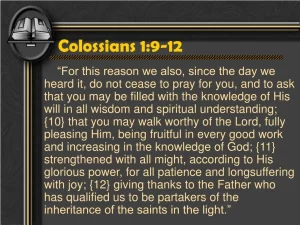
Let us explore this further. The Sixth Commandment forbids unrighteous anger, but not righteous anger. Yet at what point does righteous anger become unrighteous? No rule book can define that for us. No verse will spell that out. If the Seventh Commandment forbids lust and the Tenth coveting, at what point does admiration or appreciation cross the line into illicit desire? At what point does modesty cross the line into immodesty? At what point does charity cross the line into enabling? A thousand times a day we make decisions about how we will relate to people, our resources, our jobs, our God. We are commanded to love and be kind to our neighbours, to make wise use of our things, to work hard on our jobs, to rejoice and reverence our God. There is no book that can tell us at exactly what point we have either begun or ceased to do any of these things. We can only know them by the Holy Spirit and wisdom. The Scripture provides the essential reference points in its “thou shalt nots” and “thou shalts”. But ninety-nine out of a hundred applications are beyond the verses themselves, in the land between the lines, where the holy Spirit must lead and wisdom must instruct. Again, this is why we must pray for “discernment”, “knowledge”, “wisdom”, and “understanding” (Eph. 1:15-19; Phil. 1:9-11; Col. 1:9-12).
God wants us to have wisdom so we can evaluate our choices in life and choose the ones that lead us down a path that glorifies him. The Apostle Paul prays for the Philippians to have wisdom so that “they may approve the things that are excellent” (Phil. 1:9). He prays for the Colossians to have it so that they may “walk in a manner worthy of the Lord, to please Him in all respects, bearing fruit in every good work”, and so on (Col. 1:10-12).
The irony today could not be more pronounced. Many professing Christians are making foolish lifestyle choices, and doing so in the name of the Bible! There is no verse to forbid it, and so, off they go, plunging ahead with foolish decisions with respect to marriage, parenting, recreation, entertainment, fashion, schooling, and so on. There is much foolishness abroad today. The antidote is biblical wisdom applied to all of life.
Where does this leave us? We are battered by the world and its myriad voices and diversity of choices. What is true? What is right? What is important? God has given us an infallible standard. It is absolutely trustworthy and reliable. It gives us the truth of God regarding God himself, man, sin, salvation, eternity, ethics, values, and the proper perspective and outlook on life. It is of unsurpassed authority because it alone is the voice of God on earth, given to us by divine inspiration. It is sufficient, making us “wise unto salvation”, equipping us for “every good work” (2 Tim. 3:15-17). It does so, not through hundreds of thousands of rules, but by giving us general truths which the Holy Spirit applies in such a way as to guide us wisely in every situation, circumstance, and decision of life.
— — —
Pretty good, eh? I’ll bet you didn’t expect this citation to touch on Intelligent Design / Creation or on Christian decision-making, did you? But, of course, if Christian Scripture is indeed the inspired and infallible Word of God, sufficient and authoritative as a guide for our lives in all areas, it should not be surprising that its various doctrines hang together in one cohesive whole.