Nov
9
Lucy and the State of Hominid Evolution
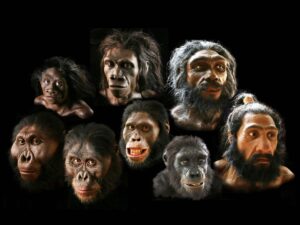
A few weeks ago, I finished reading Old-Earth or Evolutionary Creation?, ed. by Keathley, Stump, and Aguirre. You might remember the title, because I published two posts this past August in which I cited representatives of the two Christian organizations that contributed to the discussion in the book — BioLogos and Reasons to Believe (RTB). The latter part of the book included material about hominid fossils and human evolution. I know that some people interested in the creation/evolution/ID debates are confused about the RTB position on this topic, so I have decided to produce a couple more posts allowing Fuz Rana to explain this part of the RTB creation model. The following citation is pulled from the chapter titled “The Fossil Evidence: Who Were the Hominids?”.
— — —
In some respects, we regard hominins in much the same way as the majority of the scientific community: as real animals that existed in Earth’s past. (I will use the words hominid and hominin interchangeably, despite some taxonomic differences.) … Our model predicts many biological similarities between the hominids and modern humans, but also significant differences. The greatest distinctions should be related to their cognitive capacity, behavior patterns, technological development, and culture, especially artistic and religious expression….
Some might wonder how we justify our skepticism of human evolution from a scientific perspective. A thorough response to this question is beyond the scope of this chapter. [For an extensive critique of human evolution with references to original scientific sources, check out the expanded second edition of Who Was Adam? by Fuz Rana with Hugh Ross.] From our perspective, for human evolution to be valid, the transitional forms connecting australopithecines to primitive Homo specimens and in turn connecting these hominids to modern humans should be discernible in the fossil record.
At this juncture, paleoanthropologists cannot reasonably map out the naturalistic route that produced modern humans. In fact, we question whether this will ever be possible. Paleoanthropologists disagree on the evolutionary relationships among the hominids, specifically on the pathway that led to modern humans. Examination of any textbook or treatise on human evolution attests to this conflict. In light of this significant failure, we believe it is unwarranted to consider human evolution any more than a hypothesis. That human evolution occurred is as much a hypothesis as how it occurred….
Often hominid remains are crushed or shattered prior to fossilization and further deformed by geological processes. These limitations make proper analysis of the hominid fossil record very difficult. Distortions and deformations of hominid fossils obscure paleoanthropologists’ ability to construct accurate evolutionary trees. The implications are enormous for human evolutionary scenarios, as illustrated by recent fossil finds for Australopithecus afarensis, or Lucy.
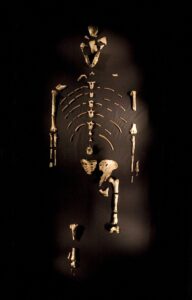
The standard evolutionary view places Lucy in the direct pathway from an apelike ancestor to modern humans. Presumably, Ardipithecus ramidus (approximately 4.5 million years ago) gave rise to Australopithecus anamensis (about 4 million years ago). This hominid evolved into A. afarensis, which later yielded Homo habilis, the first member of the genus Homo. Anthropologists believe that A. afarensis also produced a second evolutionary branch that included Australopithecus africanus and terminated with three species grouped into the genus Paranthropus: P. boisei, P. aethiopicus, and P. robustus.
Analysis of a jawbone from an A. afarensis discovered in 2002 about a mile from where paleontologists unearthed Lucy indicates — from an evolutionary vantage point — that Lucy was exclusively part of the branch leading to A. africanus and Paranthropus. Based on jawbone anatomy, Lucy could not have been directly in the line that led to modern humans. If this is the case, then Lucy’s new status leaves a two-million-year gap in the fossil record between A. anamensis and H. habilis (2.5 million years ago).
In the summer of 2010, a team of paleoanthropologists discovered fossils that composed a remarkably complete collection of postcranial remains for A. afarensis, dating to around 3.6 million years ago. Unlike the remains of the Lucy specimen (dating to around 3.2 million years ago) — which indicated that A. afarensis was a diminutive creature with apelike body proportions — the newly uncovered fossils clearly demonstrate that A. afarensis stood about five feet in height with body proportions very much like Homo erectus. This specimen also showed that A. afarensis employed obligate (i.e., it had no reasonable alternative) bipedalism, not a facultative (functional or optional) form, as was long thought to be the case for Lucy.
In other words, the Lucy specimen — which is not only the poster girl for A. afarensis but also the key hominid used to interpret the biology of other hominids in the fossil record — is anomalous and has misled paleoanthropologists for more than three decades.
Support for this new understanding of A. afarensis‘ biology and the evolutionary status of Lucy comes from another team of researchers who examined a fossil of the fourth metatarsal assigned to A. afarensis dating around 3.2 million years in age. The structure of this foot bone, recovered in the Hadar region of Ethiopia, is diagnostic of the overall structure of the foot. The architectural features of this bone indicate that A. afarensis had an arched foot just like the members of the genus Homo. This new insight implies that A. afarensis engaged in a form of bipedalism that was like that of H. erectus. That is, this species was an obligate biped, not a facultative one.
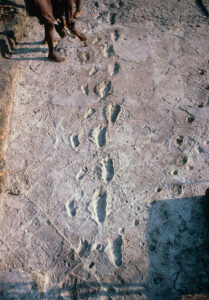
Particularly important to understanding A. afarensis‘ gait are the Laetoli footprints. These trace fossils, dating to about 3.7 million years ago, were made by three individuals walking through volcanic ash. Paleoanthropologists believe an A. afarensis family made these tracks. The Laetoli footprints have been a source of controversy. Analysis of the footprints indicates that A. afarensis must have walked like members of the genus Homo, employing obligate bipedalism. Yet the skeletal anatomy of Lucy shows that A. afarensis must have relied on a crude, facultative form of bipedalism. A modeling study published in the summer of 2012 provides additional evidence that the hominids that made the Laetoli footprints were not facultative bipeds, but instead walked like H. erectus.
It is sobering to think that the Lucy specimen, the gold standard when it comes to hominid fossils, could turn out to be an aberrant A. afarensis. (Although it should be noted that some paleoanthropologists have argued that Lucy has been improperly classified as a member of A. afarensis. In fact, they argue that she is actually a male that belongs to another hominid species. Other researchers have disputed this claim.) Lucy’s unusual anatomy has caused paleoanthropologists to formulate wrong views on the biology and behavior of A. afarensis, highlighting the extreme incompleteness of the hominid fossil record. This incompleteness makes it very difficult, if not impossible, to develop a clear understanding of hominid natural history and establish evolutionary relationships among these creatures and modern humans, assuming it exists.
The confusion surrounding Lucy’s biology and place in human evolution is not atypical. It is remarkable how frequently new hominin fossil finds force a rewrite of human evolution — over and over again.
In the midst of these difficulties, work published by Mark Collard and Bernard Wood raises serious and fundamental questions about the capability of paleoanthropologists to ever establish evolutionary relationships among hominids. In their view, any evolutionary tree paleoanthropologists construct for hominids will always be hopelessly uncertain.
Paleoanthropologists typically use comparisons of hominid cranial and dental anatomical features to build evolutionary trees, since these fossils supply the chief data available. However, as Collard and Wood point out, the use of hominid craniodental features to discern evolutionary relationships has never been validated. To make their point, these two paleoanthropologists compared evolutionary trees constructed from craniodental data with those built from DNA and protein sequences for two currently existing groups of primates. One group included humans, chimpanzees, and gorillas. The other consisted of baboons, macaques, and mangabeys.

For both sets of primates, the evolutionary trees built from DNA and protein sequences differed significantly from those constructed from craniodental data. Evolutionary biologists now consider evolutionary trees produced with molecular data inherently more robust than those derived from anatomical features. This development has forced Collard and Wood to conclude that “little confidence can be placed in phylogenies [evolutionary trees] generated solely from higher primate craniodental evidence. The corollary of this is that existing phylogenetic hypotheses about human evolution are unlikely to be reliable.”
In light of these results, “that human evolution occurred” becomes a scientifically untenable statement. In order to demonstrate that humanity originated through biological evolution, robust evolutionary trees must be established. Collard and Wood have shown that such determinations may never be possible for hominids as long as craniodental data is mostly all scientists have to work with. In fact, more recent work indicates that this problem extends beyond the hominid fossil record. Evolutionary biologists from the University of Helsinki, Finland, have questioned the reliability of any evolutionary tree generated from dental data.
Of course, it is perfectly reasonable to think that the hominin fossil record supports the notion of human evolution. But paleoanthropologists have not identified the evolutionary pathway that produced modern humans. And that being the case, it is equally reasonable to be skeptical about the fact of human evolution, on scientific grounds alone.
— — —
Those of an evolutionist persuasion like to tell the rest of us that we ignore science, don’t follow the evidence, and are biased by unscientific beliefs. To be fair, that may be true in some cases, but the accusation goes both ways. The above information provided by Dr. Rana is evidence that our ideological opponents can also let their own biases and philosophical assumptions get in the way of sound scientific conclusions, especially when defending their own preferred theory/theories.
I’ll do another post citing from Old-Earth or Evolutionary Creation? in three or four weeks, and the topic will be Neanderthals.