Nov
23
Are Illegal Immigrants Owed Due Process in the U.S.?
“Large numbers of aliens who are illegally in the country fail to appear for their scheduled hearings, most likely because they know they have no valid reason for overcoming removal and remaining in the country legally.” — Hans von Spakovsky, Senior Legal Fellow and specialist in civil rights, civil justice, the First Amendment, immigration, et al.

Federal immigration law and its enforcement is always a popular and sensitive topic, especially since every executive administration tackles it a bit (or a lot) differently. There are serious questions about how to handle people who enter (and remain in) the U.S. illegally and what sorts of legal protections they have, etc.
I came across an informative article on this topic earlier this year and finally decided to read it (it’s long-ish), and I’ll give you folks some highlights below. The article is by someone whose name may be familiar to you — Hans von Spakovsky, Manager of the Election Law Reform Initiative and Senior Legal Fellow in the Edwin Meese III Center for Legal and Judicial Studies at The Heritage Foundation. This post, and especially the original article, should prove useful the next time you get into a discussion about the legal rights of non-citizens in the United States — especially those who (re-)entered/remained illegally.
— — —
Some critics of the Trump Administration’s enforcement of federal immigration law, including members of the public, the media, and Congress, have made misleading claims about the due process rights that apply in immigration proceedings. Those who claim that non-citizens, referred to in our nation’s immigration laws as aliens, are entitled to the full panoply of constitutional rights enjoyed by American citizens are simply wrong and fail to differentiate between criminal prosecutions and immigration proceedings, which are civil matters….
Regardless of their legal status, aliens are entitled to the same constitutional due process rights provided to criminal defendants who are citizens when they are being criminally prosecuted for assault, rape, burglary, kidnapping, murder, or other crimes.
However, immigration proceedings to bar an alien’s entry or to remove or deport an alien present inside the United States are not criminal proceedings. [See the U.S. Supreme Court case Fong Yue Ting v. U.S. (1893). The decision ruled that “The [immigration] proceeding…is in no proper sense a trial and sentence for a crime or offense” and “[the] order of deportation is not a punishment for crime….]
The Court added that an alien being removed by the government is not being “deprived of life, liberty, or property” and that “the provisions of the Constitution securing the right to trial by jury and prohibiting unreasonable searches and seizures and cruel and unusual punishments [therefore] have no application.” That is also why federal immigration officers do not need a warrant issued by a judge before arresting and detaining aliens and why aliens are not entitled to be advised of their Miranda rights or to the assistance of a government-appointed lawyer during their deportation proceedings.
The fact that the removal process is a civil proceeding was reaffirmed by the Supreme Court in 2010 in Padilla v. Kentucky….
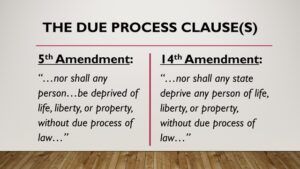
The due process rights in civil immigration proceedings are far more limited, as outlined and defined by Congress in federal immigration laws and the procedural rules promulgated by the Attorney General for the conduct of federal immigration proceedings…. Immigration “judges” are not federal judges at all; they are employees of the Justice Department who are selected by the Attorney General and who act as the Attorney General’s “delegates in the cases that come before them.” …
Aliens attempting to enter the United States have no constitutional due process rights to contest the government’s denial of their entry, and that includes (with only very limited exceptions) previously admitted aliens who are trying to reenter. Furthermore, no federal court has the authority to overrule the decision of the executive branch to exclude an alien….
Any alien who seeks admission “may not do so under any claim of right.” Such admission “is a privilege granted by the sovereign United States Government” and will be granted “only upon such terms as the United States shall prescribe.” The “exclusion of aliens is a fundamental act of sovereignty” and “stems not only from legislative power but is inherent in the executive power to control the foreign affairs of the nation.” …
The Court declared that aliens “who have once passed our gates, even illegally, may be expelled only after proceedings conforming to traditional standards of fairness encompassed in due process of law.… But an alien on the threshold of initial entry stands on a different footing.” The only “due process” to which aliens seeking to enter the country are entitled is whatever “the procedure authorized by Congress is.” That is “due process as far as an alien denied entry is concerned.”
The Court emphasized that because the “action of the executive officer” to deny admission to an alien is “final and conclusive, the Attorney General cannot be compelled to disclose the evidence underlying his determination in an exclusion case.” Thus, “courts cannot retry the determination of the Attorney General.” The fact that an alien has previously been admitted is irrelevant. As the Court outlined: “For purposes of the immigration laws,” the Court observed, “the legal incidents of an alien’s entry remain unaltered whether he has been here once before or not. He is an entering alien just the same, and may be excluded if unqualified to admission under existing immigration law.” …
Congress has provided the President with virtually unfettered authority to exclude any aliens. In addition to the multiple grounds provided in 8 U.S.C. § 1182, section (f) of the statute gives the President the right to suspend the entry of “any aliens or of any class of aliens” if he determines that their entry “would be detrimental to the interests of the United States.” …

Aliens seeking entry to the United States have no First Amendment right that would somehow give them the ability to contest the government’s refusal to admit them because of their views, opinions, or other speech. (The citizens who may have invited them to speak also have no such right.)… Even aliens who are legally inside the United States do not enjoy the full panoply of First Amendment rights. Federal campaign finance laws, for example, prohibit foreign nationals (with the exception of permanent resident aliens) from participating in local, state, and federal elections of candidates for office by making any contributions, donations, or expenditures related to campaigns — activity in which citizens have a right to engage under the First Amendment.
Additionally, Congress has imposed restrictions on lawfully present aliens that, if violated, make those aliens deportable even though such restrictions could not be imposed on a citizen because they could violate a citizen’s First Amendment rights…. An alien who “endorses or espouses terrorist activity or persuades others to endorse or espouse terrorist activity or support a terrorist organization” can also be deported….
Some aliens who are in the country illegally are subject to expedited removal, which severely limits their access to federal courts or any type of administrative hearing process. Under the Immigration and Nationality Act, an alien arriving at the border can be removed “without further hearing or review” if he or she is deemed inadmissible by an immigration officer unless the alien requests asylum or asserts a credible fear of persecution if returned to his or her native country.
This provision can also be applied to aliens who have been inside the country for less than two years and, instead of being properly admitted or paroled, had entered without inspection at an established border crossing. In other words, if an inadmissible alien attempts to enter or makes it into the country illegally but is found and detained within two years, that alien can be removed without a hearing or any other proceeding.
There is also an expedited removal proceeding for aliens convicted of one of a specified list of criminal offenses. These range from such crimes as misdemeanor shoplifting and theft all the way to felony firearms, drug offenses, domestic violence, stalking, and child abuse as well as terrorism and espionage….
[F]ederal law prohibits what is apparently happening in federal district courts where judges are presiding over aliens with outstanding deportation orders disputing their removal from the United States. Federal district courts have no original jurisdiction to decide whether an alien may remain in the United States whether through a trial or de novo review of an immigration trial court’s decision….
— — —
Pretty eye-opening, eh?
I am tempted to include more excerpts, but this it already getting sort of long. Still, if you are a glutton for punishment and want more examples and details, including regarding specific relevant court cases, you can always read the full article. On the other hand, if you scrolled down in hopes of finding a TL;DR, here is von Spakovsky’s Summary/Conclusion (italics added by me):

“As federal immigration law and court precedents make clear, aliens do not have full access to all of the constitutional rights afforded to citizens. In immigration cases, which are civil and not criminal proceedings, aliens have only certain limited due process rights as defined by Congress and prior Supreme Court precedents. Those rights differ depending on the status of the aliens and whether they are outside the United States and trying to enter this country or are already in the country, either legally or illegally, as well as their visa or other status.
Moreover, a number of federal immigration statutes bar aliens from even asserting certain claims in federal courts, prohibit any federal court from reviewing specified actions of the federal government such as enforcement of deportation orders by the Attorney General, or limit which federal courts have jurisdiction over particular claims by aliens. Federal courts that try to assume jurisdiction over such banned, prohibited, or limited claims by aliens are violating federal law, and the Supreme Court, if necessary, should tell them so.”
The more you know… 🙂