Nov
30
Neanderthals and the Case for Human Exceptionalism

A few weeks ago, I posted “Lucy and the State of Hominid Evolution”, in which I quoted Dr. Fuz Rana of Reasons to Believe (RTB) in the book Old-Earth or Evolutionary Creation?, ed. by Keathley, Stump, and Aguirre. The subject of that post was… well, pretty much exactly what the title says — “Lucy” being the name given to the world-famous, fossilized, partial skeletal remains of a hominid species believed to be part of the lineage leading to modern humans.
This time, as promised, we return to Old-Earth or Evolutionary Creation? in order to cite from Rana’s discussion about what sets modern humans apart from the hominids. In particular, he lays out the usual arguments for Neanderthals having human abilities and behaviors, as well as RTB’s reasons for disagreeing with those conclusions.
— — —
We [at RTB] view the hominids as animals created for God’s purposes and by his direct intervention. They existed for a time and went extinct. These were remarkable creatures that walked erect and possessed some level of limited intelligence and emotional capacity, as do many animals….
Our model treats hominids as analogous to, yet distinct from, the great apes. For this reason the model predicts that anatomical, physiological, biochemical, and genetic similarities exist among hominids and human beings to varying degrees. But since the hominids were not made in God’s image, we expect them to be noticeably different from humans, as reflected by their cognitive and communicative capacities, behavior, “technology”, and “culture”. Further, our model maintains that while human beings reflect God’s image in their activities, hominids did not. The RTB model asserts that humans are uniquely spiritual and hominids were not.
According to our creation model, much of human behavior ultimately stems from the image of God. Because the archaeological record is the product of behavior and activity, it supplies the means to probe for the image of God. Artifacts that result from reason, symbolic thought, technical inventiveness, and artistic, musical, and religious expression will reflect the image of God. Since our model views the hominids as animals, we predict that such image-of-God artifacts will make their first and only appearance in the archaeological record alongside modern human remains….
Over the last decade, [archaeological] finds from South Africa push the origin of symbolism to at least eighty thousand years ago…. While not conclusive, a number of studies suggest that modern human behavior emerged even earlier than seventy to eighty thousand years ago. For example, researchers have uncovered beads made from marine shells at locations in Israel (Skhul) and Algeria — locations that are remote from the ocean. This means that the shells were transported long distances before being made into jewelry. Using thermal luminescence techniques, these beads were dated to between 100,000 and 135,000 years in age.
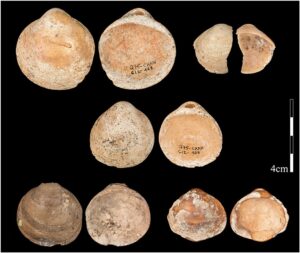
Archaeologists have also unearthed evidence of the use of red ochre and pierced marine shells in the Qafzeh Cave of Israel that date to about ninety-two thousand years ago. Investigators have recovered evidence that occupants of the Pinnacle Point Cave in South Africa were making use of pigment as far back as 165,000 years ago. All of the artifacts potentially reflect the capacity for symbolism. These observations place the origin of modern human behavior fully in line with the fossil record and genetic dates for humanity’s origin at about 150,000 years ago.
Did Neanderthals possess advanced cognitive ability? Perhaps there is no question that leads to more disagreement among paleoanthropologists. Some argue that Neanderthals were cognitively inferior to humans; others maintain that Neanderthals displayed sophisticated behavior on par with humans. If Neanderthals did possess the capacity for symbolism, that ability would be a blow to our creation model.
To make the case that Neanderthals possessed advanced cognitive ability and symbolism, some anthropologists claim that these hominids (1) buried their dead, (2) made cave art, (3) produced musical instruments, (4) fashioned body ornaments, and (5) possessed language. Yet when the archaeological evidence used to justify these claims is critically examined, the case for Neanderthal symbolism unravels.
As a case in point, some paleoanthropologists have argued that about forty thousand years ago — the time of humanity’s arrival in Europe and right before Neanderthals’ disappearance — Neanderthals evolved the capacity for modern behavior and, with it, symbolic thought. Archaeological finds in the Grotte du Renne (a French cave) provide the chief evidence for this claim. Both Neanderthals and humans occupied this cave at various times between twenty-eight and forty-five thousand years ago. The site consists of fifteen archaeological layers. Of greatest importance to paleoanthropologists is a layer containing Neanderthal teeth and artifacts such as personal ornaments, rings, pierced animal teeth, and ivory pendants — remains viewed as evidence for symbolic thought and typically connected to humans. Yet when researchers carefully applied radiocarbon dating to the cave layers, they discovered that the cave layers were mixed, perhaps by the last occupants, raising questions as to whether Neanderthals indeed possessed the capacity for symbolic thought.
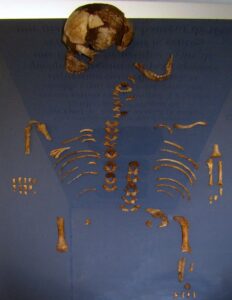
Neanderthal burials? Many anthropologists hold the idea that Neanderthals buried their dead as unassailable. In 1961 archaeologists unearthed a three-year-old child in Roc de Marsal (a cave in France) and interpreted the discovery as a deliberate Neanderthal burial. The gravesite became widely considered as an unequivocal example of an intentional entombment. Careful reexamination of the site indicates the “gravesite” was actually a natural depression in the cave floor and the child’s remains appear to have slid into this natural cavity. Over a century ago, archaeologists working in La Ferrassie Cave (France), one of the most important Neanderthal burial sites, recovered several specimens that looked as though they were buried deliberately, but appearances did not hold up under scientific scrutiny. Reanalysis of the site in 2012 suggested these findings were natural, not purposeful, burials.
Neanderthal art? Recently, researchers have claimed to find cave paintings (red disks) and etchings in the bedrock of a cave (both in Spain) that date to forty-one and thirty-eight thousand years old, respectively. Because of their early dates, anthropologists have attributed this art to Neanderthals. Yet other studies indicate that Neanderthals had disappeared from Spain (and Europe) by about forty-five thousand years ago. It also appears as if modern humans made their way into Europe earlier than previously thought, making the most reasonable candidate for the artwork modern humans, not Neanderthals.
Musical instruments? One of the most widely known examples of a Neanderthal musical instrument is the so-called bone flute recovered from a cave in Slovenia. The paleoanthropologists who made this find interpreted an eleven-centimeter bone fragment from a cave bear’s femur as a flute. This bone shaft had four evenly spaced circular openings on one side. Subsequent analysis revealed that these openings were perforations to the bone caused by hyenas that were scavenging cave bear remains.
Body ornaments? One of the most impressive examples of putative Neanderthal jewelry is the pigmented marine shells found at a site in Iberia. Marine shells were recovered next to red and yellow colorants (pigments inside a marine shell), and one shell was painted orange. Using carbon-14 dating methods, researchers dated the artifacts to be about fifty thousand years old. Researchers have also found negligible remains of a marine shell with red pigment in micropits on its surface in a cave in northern Italy. Carbon-14 dating placed the shell between forty-five and forty-seven thousand years old. As impressive as these finds are, it is premature to count them as evidence for Neanderthal symbolism. It is more reasonable to attribute these artifacts to humans. In both cases, the remains date close to the time when humans entered Europe. Again, there is a growing consensus that Neanderthals went extinct earlier than previously thought, and the dates for these two finds are close to the time that some anthropologists think Neanderthals disappeared.
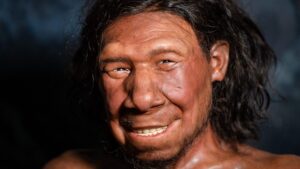
Neanderthal language? Toward the end of 2007, scientists announced the isolation of FOXP2, the so-called language gene, from a Neanderthal specimen recently discovered in Spain. Some people took this discovery as evidence that Neanderthals had language ability like that of humans. Does the presence of FOXP2 in the Neanderthal genome imply that these hominids possessed language? Not necessarily. This gene cannot be the only one responsible for human language. It is most likely that language derives from the activity of a complex network of gene interactions that dynamically vary through the course of human development. FOXP2 represents only one of these genes. Researchers have yet to catalog all the genes involved in human language ability, let alone how the genes interact to generate language capacity. What the Neanderthals possessed was a necessary condition for language, not a sufficient one.
All claims of Neanderthal symbolism are readily disputed. There is no conclusive evidence that Neanderthals had advanced cognitive ability on par with modern human cognition.
Based on the archaeological record, it is possible to make a case that modern humans uniquely possess advanced cognitive capabilities and symbolism, hallmarks of the image of God. The archaeological record also indicates that hominids possessed limited intelligence and perhaps emotional capacity, but their behavior was relatively unsophisticated compared to that of modern humans. It appears that humans alone resemble their Creator.
— — —
Rana has provided multiple examples of evolutionary scientists who, in their eagerness to “prove” their preferred theories, “jump the gun”, as it were, declaring evolutionary scenarios on the barest of “evidence”. As is typically the case, the more archaeological and paleoanthropological finds are discovered and the more closely and critically they are considered, the less that evidence supports their evolutionary paradigm.
At the very least, the evidence is neutralized in regards to the preferred theory, and sometimes it clearly works against Neo-Darwinian scenarios. Specifically in this case, the evidence increasingly supports the idea of modern humans truly being the exception in terms of advanced cognitive ability and symbolism and in line with the Christian doctrine of the Image of God.