Dec
21
What Do We Know About Nazareth?
Although I already put out a Christmas post a couple weeks ago, I came up with something else my readers might find interesting, and I didn’t feel like waiting until next year to share it.
Earlier this year, I posted “4 Easter-Related Archaeological Finds”, for which I borrowed material from Dr. Titus Kennedy’s book Unearthing the Bible. The other day, I was flipping through my copy of Kennedy’s The Essential Archaeological Guide to Bible Lands, which is organized according to region and city/town. I looked for Bethlehem, naturally, but found no such entry. (It may be too small and/or there is insufficient archaeological data to warrant a full entry.) But, I did find one for Nazareth, which is fitting since that is where Jesus of Nazareth lived for many years, beginning when he was a young lad.
So,… while it probably isn’t comprehensive, here is Kennedy’s lay-friendly summary of current archaeological knowledge about Nazareth:
— — —
The village of Nazareth in the region of Galilee is located on a ridge approximately 350 meters (1,150 feet) above sea level, west of the Sea of Galilee. Although Jesus spent most of his life in Nazareth, it was a small and insignificant village, with no written records mentioning it prior to the Gospels (Matthew 2:23; 4:13; Mark 1:24; Luke 1:26–2:4; John 1:45). Nazareth appears in a Hebrew inscription from the 3rd or 4th century AD found at the synagogue of Caesarea Maritima that refers to priests in Nazareth just after the Bar Kokhba Revolt around AD 135, and various Christian writings refer to Nazareth in the 2nd, 3rd, and 4th centuries AD, including by Tertullian, Origen, Julius Africanus, Eusebius, and Epiphanius.
Archaeological remains have been found at Nazareth from the Bronze Age and Iron Age, and then, after an abandonment period of centuries, the village seems to have been resettled in the 2nd century BC during the Hasmonean period. Excavations at Nazareth have also recovered both archaeological materials and structures dating to the Roman period, which shows that a village of approximately four hectares existed in the 1st century BC and 1st century AD during the time of Jesus.
Because of Nazareth’s small size and agricultural character, the population was probably only about 400 people, indicating why the village was unlikely to appear in historical texts and was seen as insignificant (John 1:46). From the 1st century, excavations have uncovered houses, olive oil presses, wine presses, water cisterns, a vineyard tower, a mikvah (ritual bath), quarries, tombs, pottery, coins, and ritual stone vessels. A tomb inscription also demonstrates the use of Aramaic in Nazareth. The site of the synagogue in Nazareth, however, remains unknown (Luke 4:16).
Nazareth was the location of one of the first events recorded about the life of Jesus — the annunciation of the birth of Jesus Christ, set near the end of the 1st century BC. According to the Gospel of Luke, the angel Gabriel was sent from God to tell Mary that through the power of the Holy Spirit she would conceive and bear Jesus, the Son of God (Luke 1:26-38). To commemorate this momentous event, an ancient church was built at the site thought to be the house where Mary lived before her marriage to Joseph.
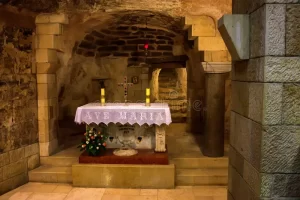
Written sources from antiquity and archaeology suggest that the Byzantine Church of the Annunciation was constructed in the 5th century AD after the reign of Constantine the Great, but that an earlier Christian building existed at the location in the 4th century AD or before. Underneath the modern Basilica of the Annunciation and the Crusader period church of the 11th century, the remains of a 5th-century AD Byzantine church were found, measuring approximately 20 meters by 8 meters. A mozaic floor from this Byzantine-period church had a dedication reading “for Konon, deacon of Jerusalem” in Greek, and a decorative cross. Below the building, a baptismal font, mosaic floors including decorative crosses, plastered walls with various graffiti, and steps leading into a cave were discovered. The graffiti had phrases such as “Lord, Christ, help your servant Valeria… and give the palm to pain… Amen” and “Lord Jesus Christ, Son of God, help Geno and Elpisius, Achille, Elpidius, Paul, Antonis… servants of Jesus.” The base of a column also has the name Mary carved into it in Greek, further linking the site with the tradition of Mary and the annunciation, although the inscription comes from after the church was already established.
The pilgrim Egeria, writing in ca. AD 383, mentions the “cave in which Mary lived” and the altar placed near the entrance, which was apparently associated with an early church there (Egeria, Itinerarium Egeriae). However, she does not mention a formal church or basilica, which suggests that Constantine did not have a commemorative church, like those in Jerusalem and Bethlehem, built there during his reign.
A coin minted around the middle of the 4th century AD was found in the plaster, demonstrating that Christians used the site at least as early as this. The building could even be the church that Joseph of Tiberias planned to build in Nazareth during the early 4th century (Epiphanius of Salamis, Panarion 30). There are suggestions from archaeological excavations that a building where Christians met may have even existed there as early as the 3rd century AD. Archaeological excavations also revealed remains of various parts of the village of Nazareth from the 1st century AD underneath this church, nearby, and in scattered locations around the area, confirming that Nazareth was indeed occupied during the time of Jesus.
The excavation of another 1st-century structure in Nazareth, near the Church of the Annunciation, provides additional insight into the ancient village, with analysis showing that a family observing the Law of Moses lived there during the 1st century and the time of Jesus. Interestingly, this house had another church built around it during the Byzantine period, and it was revered as the childhood home of Jesus. The Church of the Nutrition, as it is called, and its accompanying 1st-century house designated “Structure 1,” are located in Nazareth beneath the convent of the Sisters of Nazareth, which is up the street from the Church of the Annunciation. When constructed, the church was cut into the rocky hillside, and the rest of the structure was built with stone and mortar. It is a courtyard-style house, and one of the doorways stands intact. The ground floor was chalk, and a staircase led to an upper floor. Stone, being prevalent in this area, was the most obvious and economical material for construction.
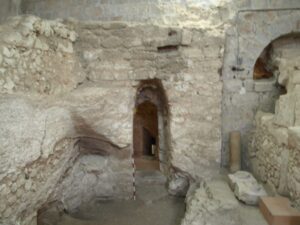
Inside the house were discovered remnants of cooking pots, a spindle wheel for textile manufacture, and ritual limestone vessels. Since earthenware vessels can become ritually impure and are then intentionally destroyed, whereas stone vessels and other materials such as metal do not become ritually impure, these limestone vessels serve as a useful indicator of the traditions of the people and are important for identifying the residents as those who observed the Law of Moses rather than those who follow Hellenistic or Roman cultural norms (Leviticus 6:28; 11:33; 15:12). The house was then abandoned later in the 1st century AD.
When a church was constructed around the house in approximately the 5th century AD during the Byzantine period, decorative mosaic floors, marble column capitals, four apses, and possibly an altar in the Byzantine style were used. An inscription carved into marble appearing to read “Christo” was also discovered. Coins discovered in the cave-church structure imply that a community of Christians in Nazareth met there at least as early as the 4th century AD, at the beginning of the Byzantine period when many of the most important churches associated with the life of Jesus were built. This intricately decorated Byzantine church, which was itself built over an older cave-church, shows an even earlier tradition of reverence around the original house.
A Latin text called De Locis Santis from ca. AD 670, based on a pilgrimage by Bishop Arculf, describes Nazareth as having two churches, one of which is beside a house. It goes on to describe the house as the one in which Jesus was nourished in his infancy.
— — —
Information like this, being careful not to overplay its significance, is helpful in understanding the history of a place in general, as well as how it supports the biblical record.
Have a Joyful Christmas!