Feb
15
Is Trump Illegally Using the Military in the U.S.?
“Many today claim that the Posse Comitatus Act of 1878 (PCA) prohibits the use of the military in domestic affairs. But they completely misunderstand that law.” — Mackubin Thomas Owens, author and expert on national security affairs
This past week I read a very good article by Mackubin Thomas Owens in Hillsdale’s Imprimis newsletter. I had never heard of Owens before (and I would have remembered that first name!), but according to his bio:
“Owens is a senior national security fellow at the Foreign Policy Research Institute, editing its journal Orbis from 2008 to 2020. A Marine Corps infantry veteran of the Vietnam War, he was a professor of national security affairs at the U.S. Naval War College from 1987 to 2015. He received his… Ph.D. in Politics from the University of Dallas. He has published essays and articles on national security issues for several publications, including National Review, The New York Times, and The Wall Street Journal and is the author of U.S. Civil–Military Relations after 9/11: Renegotiating the Civil–Military Bargain.”
I have extracted (and very lightly edited) a “short version” of the article below, laying out the three primary examples of questioned utilization of U.S. military forces by President Trump within our nation’s borders and potentially against U.S. citizens.
— — —
Seditious Video?
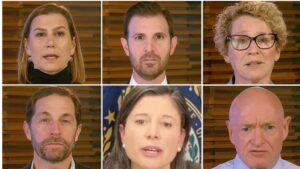
During his second term, many of Trump’s political enemies have taken up where [Georgetown Law Professor] Rosa Brooks left off. Perhaps the most troubling example occurred recently when six Democrat members of Congress posted a video aimed at service members. The video features U.S. Senators Elissa Slotkin of Michigan and Mark Kelly of Arizona and U.S. Representatives Maggie Goodlander of New Hampshire, Jason Crow of Colorado, and Chris Deluzio and Chrissy Houlahan of Pennsylvania — all of whom are either military veterans or former intelligence officials. [See image below.]
In the video, the lawmakers “remind” active members of the military and national security community that they swore to protect and defend the U.S. Constitution. “Right now, the threats to our Constitution aren’t just coming from abroad, but from right here at home,” Deluzio, a former Navy officer, and Crow, a former Army Ranger and paratrooper, say in turn. Kelly, a former Navy Captain, then says, “Our laws are clear: You can refuse illegal orders,” which Slotkin, a former CIA officer, repeats. Crow then adds that military members “must refuse illegal orders” before the others say, “No one has to carry out orders that violate the law or our Constitution.” And they all pledge that when service members refuse to carry out illegal orders, “We have your back.”
Of course, regarding unlawful orders, these members of Congress are correct. All service members learn early in their training that they have an affirmative obligation to refuse unlawful orders. But service members do not get to refuse orders because they disagree with the administration’s policies. And this video, at the very least, carelessly blurs the line between these things in a way to undermine trust between civilian policymakers and the military and between seniors and subordinates within the military.
The video was clearly political in nature and is likely to foster confusion within the military ranks. The lawmakers failed to identify any specifics regarding unlawful orders. Nor did they offer examples of the kinds of orders soldiers should refuse to obey. Without context, the phrase “refuse illegal orders” blurs the line between legitimate legal instruction and political signaling. For a system that depends on discipline, clarity, and stability, ambiguity is a real problem.
The civil–military implications are serious. Civilian control of the military rests on a clear hierarchy. Congress passes laws, the executive directs operations, and the military follows lawful commands. By addressing the troops directly about which orders to follow, the participants in the video disrupt that structure. Military leaders, not legislators, are responsible for issuing guidance to troops on how to evaluate or report questionable orders. The seriousness of the issue is underlined by the fact that the video comes from politicians rather than military authorities. The video draws service members into a political dispute, sowing discord, which is especially dangerous during periods of political tension.
The President and his supporters have called the video seditious. There have been suggestions that at least one of the lawmakers in the video, Senator Kelly, be called back to active duty to face a court-martial. [S]ome conservative lawyers, such as Jonathan Turley and Andrew McCarthy, have argued that a sedition case would be dismissed immediately, because those on the video were exercising their right to free speech. But one’s right to oppose a policy does not extend to efforts to interfere with those obligated to execute that policy — which is the effect of the video, intended or not….
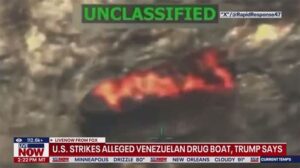
When queried, the six lawmakers in the video were unable to identify a single example of an “unlawful order” issued by Trump or his administration. That changed temporarily in late November when The Washington Post reported, citing anonymous sources, that Secretary of War Pete Hegseth had ordered an illegal second strike on a drug boat aimed at killing drug traffickers. Accusations of war crimes quickly dissolved, however, as The New York Times followed up with a story debunking the Post’s account, and Admiral Frank Bradley, who himself ordered the second strike, testified before Congress.
Nonetheless, the question of the legality of military strikes on drug cartels remains a source of the claim that the Trump administration is operating outside the law. Another source for that claim is the administration’s use of military force in cases of domestic disorder. In both cases, Trump’s policies have historical precedents.
Domestic Disorder
Trump’s critics claim that deploying National Guard and regular U.S. military forces to enforce the law in American cities violates civil–military norms, is unconstitutional, and is an irresponsible use of the professional military. But while there may be good reasons to limit the use of the U.S. military in domestic affairs, U.S. troops have been so employed since the beginning of our republic. Indeed, the U.S. Army Historical Center has published three 400-page volumes on the use of federal military forces in domestic affairs.

The authority of the president to use force in response to domestic disorder arises from the Constitution itself. Section 4 of Article IV reads: “The United States shall guarantee to every State in this Union a Republican Form of Government, and shall protect each of them against Invasion; and on Application of the Legislature, or of the Executive (when the Legislature cannot be convened) against domestic Violence.”
The fundamental purpose of a republican government is to protect its citizens’ rights to life, liberty, and property. Although the First Amendment to the Constitution guarantees “the right of the people peaceably to assemble, and to petition the Government for a redress of grievances,” it does not protect riot, arson, and looting.
Under Article II of the Constitution, the president, as “Commander in Chief of the Army and Navy of the United States” — and of the militia when under federal control — has the authority to act against enemies both foreign and domestic….
In 1807, at the behest of President Thomas Jefferson — troubled by his inability to use the regular Army as well as the militia to deal with the Aaron Burr conspiracy to establish an independent country within the U.S. — Congress passed the Insurrection Act. Although intended as a tool for suppressing rebellion when circumstances “make it impracticable to enforce the laws of the United States in any State or Territory by the ordinary course of judicial proceedings,” it also enabled the Army to enforce federal laws, not only as a separate force, but also as part of a local posse comitatus (a group conscripted to enforce the law)….
Those who have criticized President Trump for threatening to use the National Guard and possibly the Marines “against the will of state governors” might want to consider what happened when some southern governors refused to execute the 1954 Supreme Court mandate to integrate schools. In 1957, Arkansas Governor Orval Faubus deployed his state’s National Guard to defy federal authority by preventing the integration of a high school in Little Rock. President Dwight D. Eisenhower responded by placing the Arkansas National Guard under federal control and deploying soldiers of the 101st Airborne Division to enforce the law. In a letter to Eisenhower, Democrat U.S. Senator Richard Russell of Georgia compared soldiers of the 101st Airborne Division to Hitler’s “storm troopers,” illustrating that the argumendum ad Hitlerem often deployed against Trump is nothing new.
Many today claim that the Posse Comitatus Act of 1878 (PCA) prohibits the use of the military in domestic affairs. But they completely misunderstand that law.
In the election of 1876, President Ulysses S. Grant deployed Army units as a posse comitatus — under the authority of local law enforcement officials — to protect the rights of black citizens and Republicans in general at southern polling places. In that election, Rutherford B. Hayes defeated Samuel Tilden with the disputed electoral votes of South Carolina, Louisiana, and Florida. Southerners claimed that the Army had been misused to “rig” that election, which led to the passage of the PCA two years later. But the PCA only prohibits federal troops from being placed under lesser authorities than that of the president. It does not constitute a bar to the use of the military in domestic affairs, and it certainly does not limit the president’s authority as Commander in Chief of the U.S. military….
Drug Trafficking
Trump’s critics charge him with violating both domestic and international law by using the U.S. military to target drug cartels and drug runners, claiming that his actions are unprecedented. But as far back as the Reagan administration in 1986, U.S. Army infantry and aviation assets operated with Bolivian forces against drug producers in that country. And in 1993, President Bill Clinton issued a Presidential Decision Directive on Counternarcotics in the Western Hemisphere, assigning a substantial role in drug interdiction to the military.
The National Defense Authorization Act of 1995 authorized use of military assets in drug interdiction: 14 USC Section 526 authorizes firing on vessels carrying drugs, and 8 USC Section 1189 authorizes the designation of narco-terror groups as Foreign Terrorist Organizations, unlocking powers used by every administration since 9/11. As for international law, the United Nations Convention on the Law of the Sea authorizes military force against suspected stateless vessels engaged in piracy and slave trafficking, essentially labeling them hostis humani generis, meaning enemies of mankind.
The Trump administration has proceeded in accordance with legal prudence. Admiral Alvin Holsey, Commander of U.S. Southern Command, properly sought legal justification for the strikes on suspected drug boats. Subsequently, the Justice Department Office of Legal Counsel advised the Pentagon that the strikes were legal under both U.S. and international law, that all strikes have been conducted in “complete compliance with the law of armed conflict,” and that U.S. troops would not be exposed to prosecution for carrying out the orders. It is legitimate to argue that Trump’s policy regarding these strikes is wrongheaded, but it is not unprecedented. Indeed, his interpretation of what constitutes the boundary of his military authority is historically ordinary…. Any arguments against his policies must be made in terms of prudence, not the Constitution or the law.
— — —
Note that Owens’ defense is not that of a MAGA fanatic, and the reasoning (and caution) applies to any president in such a position. Also, as you may have guessed from statements made in the first half of the above citation, Owens’ full article is more broadly concerned with the need for healthy civil-military relations, which involve “mutual trust between civilians and the military, leading to a respectful give and take.” You should go read it: “The Dangers of Undermining U.S. Civil–Military Relations”.