Feb
22
The Species Pair Challenge
“If unguided evolution really can do its magic, this should not be too difficult. However, if the challenge cannot be met, Darwinists must be asked to explain why.” — Günter Bechly, paleo-entomologist (CSC)

As I was scrolling through some notes the other day, I found that I had been holding onto the URL for an article (from 2024) by Günter Bechly, so I finally read it. As some of you may know, Bechly was a noted German paleontologist and entomologist with a particular specialty in ancient butterflies. He served as curator for amber and fossil insects in the department of paleontology at the State Museum of Natural History (SMNS) in Stuttgart, Germany. He eventually came to reject Neo-Darwinian theory and leaned increasingly toward Intelligent Design, working as a senior fellow of the Center for Science and Culture (CSC) at the Discovery Institute in Seattle since 2016. Bechly remained with CSC until his untimely passing in early 2025.
In the article in question, “Fossil Friday: Three Modern Scientific Challenges to the Causal Adequacy of Darwinian Explanations”, Bechly examines the issues and objections to 1) the Waiting Time Problem; 2) the Species Pair Challenge; and 3) the Collapsing Tree Problem. To be fair, the article is pretty long, and some parts I only skimmed. But, I was particularly interested in the middle section (plus it was a bit shorter), and that is what I have reproduced for you below.
Allow me to preface with a quote from Bechly’s opening remarks:
“As I have demonstrated in great detail in numerous lectures and articles (see Bechly 2024d), the fossil record consistently documents a series of saltational transitions with abrupt appearances of new body plans and bursts of biological novelty within very short windows of time, which have been called revolutions, explosions, and ‘Big Bangs’ by mainstream evolutionary biologists for good reason (also see Bechly 2021, 2023a, Bechly & Meyer 2017). This phenomenon is ubiquitous in all periods of Earth history, in all geographical regions, and in all groups of organisms, from protists and plants to invertebrate and vertebrate animals.
These discontinuities in the history of life not only contradict the Darwinian core prediction of gradualism (i.e., an accumulation of small changes over long periods of time), but also raises another fatal problem for the feasibility of any unguided process as adequate explanation for the major transitions in the history of life (macroevolution).”
He then delved into the Waiting Time Problem, but we’re going to skip to the Species Pair Challenge…
— — —
Finally, there is also another problem that has been hitherto largely overlooked: The morphological similarity of modern species pairs that have diverged in a similar time frame poses a severe problem, because it implies that the macroevolutionary processes that were at work and common in the history of life in all periods of Earth history and all groups of organisms, apparently were totally absent in the origins of all of the millions of living species.

To make this point I surveyed TimeTree.org (Hedges and Kumar 2009, Hedges et al. 2006, 2015, Kumar et al. 2017), which is a databank of 148,876 living species of all kinds of organisms with molecular clock estimates of their time of divergence based on 4,185 studies. When probing any pairs of species, even those with longer divergence times than available for the development of the body plan differences between for example pakicetids and basilosaurids (separated by about 4-5 million years), we find without exception that their morphologies are hardly distinguishable for laymen and they often still can hybridize.
Here are a few examples from TimeTree (the datings have been updated compared to Bechly 2022a, based on the most recent version of the TimeTree database):
o Firs (Abies spec.) and cedars (Cedrus spec.) belong to the same subfamily of conifer trees but separated already 136 million years ago;
o common house fly (Musca domestica) and small house fly (Fannia scalaris) diverged 39-45 mya;
o northern damselfly (Coenagrion hastulatum) and azure damselfly (Coenagrion puella) diverged 11.8 mya;
o European common frog (Rana temporaria) and moor frog (Rana arvalis) diverged 13.2 mya;
o Galapagos land iguanas (Conolophus spec.) and Galapagos marine iguanas (Amblyrhynchus spec.) diverged 23.9-24.2 mya (marine iguanas can excrete salt from a gland at their nostrils and have a more flattened tail, but otherwise still look very much like their cousins);
o green warbler (Phylloscopus nitidus) and Bonelli’s warbler (Phylloscopus bonelli) diverged 15.2 mya (at least 4-7 million years according to Helbig et al. 1995) but look almost identical and can still hybridize (this pattern is typical for birds);
o house sparrow (Passer domesticus) and tree sparrow (Passer montanus) diverged 5.6 mya and still can hybridize in the wild;
o house mouse (Mus musculus) and rat (Rattus norvegicus) diverged 11.6-13.1 mya (at least 12 million years according to Kimura et al. 2015);
o European bison (Bison bonasus) and aurochs / house cattle (Bos taurus) diverged 3.56 mya and still can hybridize as beefalos;
o horses (Equus caballus) and ass (Equus asinus) diverged 11.1 mya and still can hybridize as mules;
o Asian elephant (Elephas maximus) and African elephant (Loxodonta africana) diverged 8.4 mya (at least 7.6 million years according to Rohland et al. 2007), and even African savannah elephants (L. africana) and the very similar forest elephants (L. cyclotis) diverged 5.5 mya (at least 4 million years according to Rohland et al. 2007);
o spectacled bears (Tremarctos ornatus) and Asian black bear (Ursus / Selenarctos thibetanus) diverged 13.9 million years ago and can still hybridize in captivity (Mondolfi & Boede 1981);
o river otter (Lutra lutra) and brown fur seal (Arctocephalus pusillus) diverged 40 mya (still a far cry from the difference between pakicetids and basilosaurids in a tenth of the time);
o river hippo (Hippopotamus amphibius) and pygmy hippo (Choeropsis liberiensis) diverged 7.0 mya (hippos represent the closest living relatives of whales);
o common dolphin (Delphinus delphis) and bottlenose dolphin (Tursiops truncatus) diverged 2.25 mya (this is more than twice the available time of the transformation of quadrupedal protocetids to fully marine pelagicetids, but only achieved minor differences).
Most of these recent species pairs only differ in allometric measures and minor color pattern. They usually look so similar that they could hardly be distinguished by laymen, even though they were separated for a much longer time than was available for most major transitions in the fossil record.
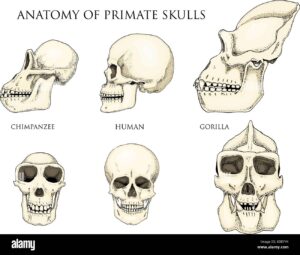
So, what about great apes and humans? Chimp (Pan paniscus) and gorilla (Gorilla gorilla) diverged according to TimeTree 8.6 million years ago and humans (Homo sapiens) from chimps 6.4 million years ago, which agrees with the hominin fossil record. There are two possibilities: Either you follow those scientists who consider the biological difference between humans and chimps as marginal. Then this example would just confirm the pattern described above. Or, you consider humans as very different from chimps, based on their different bipedal locomotion and especially their mental capacity and cultural achievements. In the latter case humans would represent the only exception to the pattern that I could find, which arguably would represent a remarkable confirmation of Judeo-Christian human exceptionalism.
These examples could be expanded endlessly but should be sufficient to establish the point. There are clearly limits to what unguided evolution can do within a few million years, and these limits are far below the level of any major body plan transitions. Thus, we can safely conclude that there are two indisputable facts that require an adequate explanation:
1.) There are many examples of fossil species pairs with very different body plans that diverged within a window of time of 5 (±5) million years. This is even more remarkable if we consider that there are only about 350,000 described fossil species (extrapolated based on data in Teichert 1956, Valentine 1970, Raup 1976, and Alroy 2002), which represent only a tiny fraction of the estimated 5-50 billion species that have ever lived on Earth (Raup 1991).
2.) There exist no living species pairs with even remotely similar differences in body plan that are dated to have diverged in a similar time frame. This is even more remarkable if we consider that there are an estimated 8.7 million living species (Mora et al. 2011, Strain 2011, Sweetlove 2011), of which more than 2 million are described (IISE 2012). Previous estimates of the total number of living species varied from 3-100 million species (May 1988, Tangley 1997, Chapman 2009), but if microbes are included, it could even be up to a trillion living species (Locey & Lennon 2016, Latty & Lee 2019).
Considering the fact that windows of time of only 5-10 million years account for most of the abrupt appearances of new body plans in the fossil record (Bechly & Meyer 2017, Bechly 2021), the Bayesian likelihood of not finding a single example of similar morphological disparity having originated on a similar time frame among the millions of living species is basically close to zero. I consider this simple argument as a final nail in the coffin of Darwinian unguided evolution.
Based on this argument, I formally and publicly posed the following challenge to evolutionary biologists (Bechly 2022a): find in the vast database of almost 149,000 species at TimeTree.org just a single example of any pair of different species that have diverged about 5 million years ago (give or take a few million years) according to a consensus of multiple molecular clock studies, and that exhibit a morphological disparity in their body plans comparable to, say, Pakicetus and Basilosaurus. To be clear, of course no evolutionary biologist ever claimed that Pakicetus was the actual ancestor of Basilosaurus. It rather represented a side branch of the cetacean stem group. But it definitely does imply that the stem species was roughly similar in body plan to Raoellidae and Pakicetidae. Therefore, this challenge is absolutely valid and reasonable.
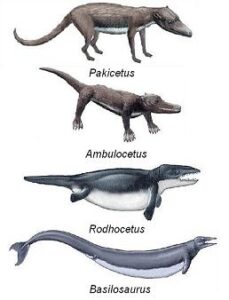
There is no conceivable reason why a disparity like that between Pakicetus and Basilosaurus should be limited to the fossil record, where it can be found in numerous examples among all groups of organisms, while being totally absent among the millions of recent species. So, the challenge could even be formulated in a more relaxed and generous way, which is not restricted to the TimeTree database. Just find any pair of species among the millions of living species to meet the challenge; just a single example! If unguided evolution really can do its magic, this should not be too difficult. However, if the challenge cannot be met, Darwinists must be asked to explain why.
An obvious possible objection to the species pair challenge might be, that such recent species pairs do not represent ancestor-descendent lineages but just sister- or cousin-lineages that both diverged from a common ancestor. However, this also applies for most fossil examples, and indeed makes the case even more problematic. While differences in ancestor-descendent lineages could only accumulate in a single evolving lineage, sister-lineages could both evolve differences during the same time and thus should rather present more and not less morphological disparity. Evidently, actualistic explanations fail in the case of major transitions in the fossil record. This arguably represents powerful independent empirical confirmation for the hypothesis that microevolutionary (population genetic) processes cannot be extrapolated over large periods of time as sufficient explanation for the origin of complex biological novelties in the history of life.
Maybe evolutionists will appeal to yet unknown non-Darwinian processes (see above). However, the great advantage of this new argument is that it is totally independent of the nature of the transformation process. You could simply consider that process as a black box. Therefore, it is totally irrelevant if Darwinists invent some new possible mechanism. The crucial point is not the process, but the resulting pattern of new body plans consistently having come into being abruptly in the distant past, but not in the more recent past.
So, how did evolutionary biologists react to this new challenge? Mostly crickets, except for some discussion at the Peaceful Science forum, where Prof. Arthur Hunt, a botanist and soil scientist from the University of Kentucky, suggested that a group of Hawaiian endemic plants called the Hawaiian Silversword Alliance does meet the challenge. I refuted this claim in an article (Bechly 2022b), which showed that the very different growth forms are mostly due to phenotypic plasticity and even occur within the same species. Again nothing but crickets. A year later the challenge still stands and lacks any serious response, which is quite telling and shows that the raised issue is a genuine and valid problem that requires an adequate explanation.
In my view the cumulative evidence suggests that the only adequate explanation is that Darwinism is wrong, and this applies not only to the Neo-Darwinian process of random mutation and natural selection but to any unguided evolutionary processes including those suggested by proponents of the so-called Extended Synthesis (e.g., Shapiro et al. 2014, Laland et al. 2014, 2015, Garte 2016, Müller 2016, 2017). There is no evolutionary reason why the creative power of this process should have been active over all of Earth history but then ceased to function within the past 10 million years.

Intelligent design proponents can easily explain this pattern: there was creative intelligent intervention in the history of life, but this creative activity deliberately ceased with the arrival of humans as the final telos. Any further identification of the intelligent cause would have to transgress the methodological limits of the design inference, but Judeo-Christian theists will certainly recognize an eerie correspondence with the Biblical message, which says that God rested from his creative activity after the creation of humans (Genesis 2:2-3).
— — —
Quite the provocative challenge, made even more controversial by the admission that the scientific evidence does not support any current model of unguided evolution but is rather compatible with the Judeo-Christian teaching on God’s creation and human exceptionalism.
You can read Bechly’s full article here.