Sep
20
Venezuela, Iran, and the World Oil Market
“We’re in the eye of the hurricane. But the storm is passing, and it’s going to be very advantageous for the United States in the next decade.” — Victor Davis Hanson

I read an interesting commentary — broadcast transcript, actually — by Victor Davis Hanson the other day. If you are unfamiliar with Hanson, he is the Martin and Illie Anderson senior fellow in residence in classics and military history at the Hoover Institution at Stanford University, a professor emeritus of classics at California State University, Fresno, and the Wayne and Marcia Buske distinguished fellow in history at Hillsdale College. He is an author, columnist, and video commentator for Daily Signal — that last one being the source for the commentary below.
The full piece is titled “Victor Davis Hanson: America Looks Nothing Like She Did 5 Years Ago — And That’s a Good Thing”, and I reproduced a good-size chunk of it below. FYI, the transcript was lightly edited by the D.S. crew, and I did the same in a few places (note the square brackets) to hopefully make what he was saying a little clearer….
— — —
How about Venezuela? Is it importing terrorism and narcotics to North America? No. We just signed a deal that will essentially allow the United States, for 100 years, to have access to 65 billion barrels of high-sulfur, thick, but very valuable Venezuelan oil. They get $19, no matter what, without spending a dime, off every barrel that the oil companies try to extract.
And if you do the math, the cost in Venezuela is not [like it is for] Saudi Arabia [or] the United States. It’s not light sweet crude. It’s not easy. It’s a politically difficult place. It’s a geographically and climate-challenged place, and it will cost those oil companies anywhere from $30 to $40 to $50. And if oil goes below $65, it’s going to be hard to see how they make a profit.
It’s good for Venezuela. That’s why they agreed to it.
But more importantly, all of South America and all of the Caribbean and all of Central America is unrecognizable from five years ago when Joe Biden entered office. There is no problem now with the Panama Canal. Cuba is on the ropes. There[ are] only five governments in Latin America that are anti-American. The vast majority are capitalist, democratic, pro-American.
Go to the Middle East. One of the biggest problems we’ve had the last 50 years in the Middle East, one of the biggest, the biggest, is Iran. But not just Iran, its proxies: the Houthis, Hamas, Hezbollah. There was no Lebanon. It was kidnapped by Hezbollah.
You heard the Lebanese prime minister the other day. He said, for the first [time], there’s real opportunity in Lebanon. Why? Because Hezbollah has been defanged by Israel, but more importantly, [Hezbollah] has no money. Why? Because we have the strictest sanctions, embargoes, that we’ve ever seen on Iran.
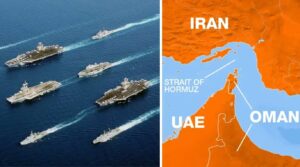
And as Iran, as we hear, is “winning” the war, they’re just about kaput. They’re strangled. We talked about an Anaconda program. Their military has been degraded by about 90%, but more importantly, they have no oil. No oil is getting in. They even have gas [station] lines in their own country. Their currency is worthless. They’re the pariah of the world.
I heard not long ago a prominent political scientist say everybody was rooting for Iran and not for us. They may have said that, but they’re going to be delighted to see that country implode, which it will.
It’s not that the war is going bad or going good. It’s that the war is irrelevant. In other words, our life goes on and Iran’s doesn’t, and time is on our side. Maybe it’s going to be six weeks. Maybe it’s going to be six months. But it cannot survive the economic sanctions that are now in place.
And the entire Middle East is starting to wake up and see that there’s a really good chance to go to a normal regional atmosphere without that pernicious, toxic government.
The Strait of Hormuz is going to be irrelevant in two or three years. Pipelines are already in progress that will bypass the Strait of Hormuz.
And when you look at the oil situation in the world, everybody says, “Well, China has got the largest storage capacity of oil and it’s full.” Yes, but it’s finite. They’re not producing it. They’re storing it.
And in fact, they’re helping us out in an indirect way because the price of oil has not gone up because China is not on the market now, because it can’t get its hands on Venezuelan and Iranian oil.
But when Iran is out of the question, oil prices will not just drop, I think they’ll crash. And who’s going to control most of the oil in the world? The United States, because it’s got this good deal with Venezuela, and it’s already the largest producer of natural gas.
— — —
I claim no expertise on these matters, but Hanson appears to make pretty good points, even if a couple seem somewhat counterintuitive. What say you?
(Here is the link to the full transcript.)