Apr
12
Labor Unions Don’t Raise Wages (and Other Harsh Truths)
Some people love unions, some people hate them, and others just tolerate them as an unavoidable reality in their lives.
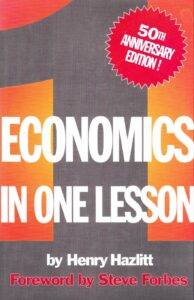
Fortunately, I’ve never been pressured into joining a labor union nor had to deal with one from the management side. For a long time I just assumed that doing so was pretty much as we see in films and on TV — a mix of positive (fighting for better wages and against unsafe working conditions) and negative (all sorts of graft and violence, usually stoked by the criminal element). I still recognize that there have been and can be positive benefits to having a labor union, but the more I learn about economics and capitalism, the more I realize that most labor unions do much more damage than good.
In this final post citing from Henry Hazlitt’s Economics In One Lesson, I quote a large chunk of “Chapter XX: Do Unions Really Raise Wages?”. (Believe it or not, the post is shorter than originally planned, because I cut out a 1-page section about strikes and strikebreakers.) I hope you read it through, because Hazlitt explains the lies, assumptions, and misconceptions that keep people from understanding the issue.
— — —
The belief that labor unions can substantially raise real wages over the long run and for the whole working population is one of the great delusions of the present age. This delusion is mainly the result of failure to recognize that wages are basically determined by labor productivity. It is for this reason, for example, that wages in the United States were incomparably higher than wages in England and Germany all during the decades when the “labor movement” in the latter two countries was far more advanced.
In spite of the overwhelming evidence that labor productivity is the fundamental determinant of wages, the conclusion is usually forgotten or derided by labor union leaders and by that large group of economic writers who seek a reputation as “liberals” by parroting them. But this conclusion does not rest on the assumption, as they suppose, that employers are uniformly kind and generous men eager to do what is right. It rests on the very different assumption that the individual employer is eager to increase his own profits to the maximum.
If people are willing to work for less than they are really worth to him, why should he not take the fullest advantage of this? Why should he not prefer, for example, to make $1 a week out of a workman rather than see some other employer make $2 a week out of him? And as long as this situation exists, there will be a tendency for employers to bid workers up to their full economic worth.
All this does not mean that unions can serve no useful or legitimate function. The central function they can serve is to improve local working conditions and to assure that all of their members get the true market value of their services.

For the competition of workers for jobs, and of employers for workers, does not work perfectly. Neither individual workers nor individual employers are likely to be fully informed concerning the conditions of the labor market. An individual worker may not know the true market value of his services to an employer. And he may be in a weak bargaining position. Mistakes of judgment are far more costly to him than to an employer.
If an employer mistakenly refuses to hire a man from whose services he might have profited, he merely loses the net profit he might have made from employing that one man; and he may employ a hundred or a thousand men. But if a worker mistakenly refuses a job in the belief that he can easily get another that will pay him more, the error may cost him dear. His whole means of livelihood is involved. Not only may he fail to find promptly another job offering more; he may fail for a time to find another job offering remotely as much. And time may be the essence of his problem, because he and his family must eat. So he may be tempted to take a wage that he believes to be below his “real worth” rather than face these risks. When an employer’s workers deal with him as a body, however, and set a known “standard wage” for a given class of work, they may help to equalize bargaining power and the risks involved in mistakes.
But it is easy, as experience has proved, for unions, particularly with the help of one-sided labor legislation which puts compulsions solely on employers, to go beyond their legitimate functions, to act irresponsibly, and to embrace short-sighted and antisocial policies. They do this, for example, whenever they seek to fix the wages of their members above their real market worth. Such an attempt always brings about unemployment. The arrangement can be made to stick, in fact, only by some form of intimidation or coercion.
One device consists in restricting the membership of the union on some other basis than that of proved competence or skill. This restriction may take many forms: it may consist in charging new workers excessive initiation fees; in arbitrary membership qualifications; in discrimination, open or concealed, on grounds of religion, race, or sex; in some absolute limitation on the number of members, or in exclusion, by force if necessary, not only of the products of nonunion labor, but of the products even of affiliated unions in other states or cities….
Emotional economics has given birth to theories that calm examination cannot justify. One of these is the idea that labor is being “underpaid” generally. This would be analogous to the notion that in a free market prices in general are chronically too low. Another curious but persistent notion is that the interests of a nation’s workers are identical with each other, and that an increase in wages for one union in some obscure way helps all other workers. Not only is there no truth in this idea; the truth is that, if a particular union by coercion is able to enforce for its own members a wage substantially above the real market worth of their services, it will hurt all other workers as it hurts other members of the community….
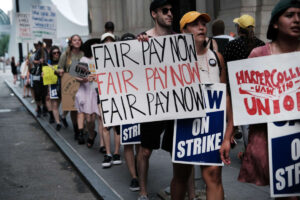
Unemployment need not necessarily be greatest, in percentage terms, among the unions whose wages have been advanced the most; for unemployment will be shifted and distributed in relation to the relative elasticity of the demand for different kinds of labor and in relation to the “joint” nature of the demand for many kinds of labor. Yet when all these allowances have been made, even the groups whose wages have been advanced the most will probably be found, when their unemployed are averaged with their employed members, to be worse off than before. And in terms of welfare, of course, the loss suffered will be much greater than the loss in merely arithmetical terms, because the psychological losses of those who are unemployed will greatly outweigh the psychological gains of those with a slightly higher income in terms of purchasing power.
Nor can the situation be rectified by providing unemployment relief. Such relief, in the first place, is paid for in large part, directly or indirectly, out of the wages of those who work. It therefore reduces these wages. “Adequate” relief payments, moreover, as we have already seen, create unemployment. They do so in several ways. When strong labor unions in the past made it their function to provide for their own unemployed members, they thought twice before demanding a wage that would cause heavy unemployment. But where there is a relief system under which the general taxpayer is forced to provide for the unemployment caused by excessive wage rates, this restraint on excessive union demands is removed. Moreover, as we have already noted, “adequate” relief will cause some men not to seek work at all, and will cause others to consider that they are in effect being asked to work not for the wage offered, but only for the difference between that wage and the relief payment. And heavy unemployment means that fewer goods are produced, that the nation is poorer, and that there is less for everybody….
It is usually assumed that an increase in wages is gained at the expense of the profits of employers. This may of course happen for short periods or in special circumstances. If wages are forced up in a particular firm, in such competition with others that it cannot raise its prices, the increase will come out of its profits. This is less likely to happen if the wage increase takes place throughout a whole industry. If the industry does not face foreign competition it may be able to increase its prices and pass the wage increase along to consumers. As these are likely to consist for the most part of workers, they will simply have their real wages reduced by having to pay more for a particular product. It is true that as a result of the increased prices, sales of that industry’s products may fall off, so that volume of profits in the industry will be reduced; but employment and total payrolls in the industry are likely to be reduced by a corresponding amount.
It is possible, no doubt, to conceive of a case in which the profits in a whole industry are reduced without any corresponding reduction in employment — a case, in other words, in which an increase in wage rates means a corresponding increase in payrolls, and in which the whole cost comes out of the industry’s profits without throwing any firm out of business. Such a result is not likely, but it is conceivable….

The exploitation of capital by labor can at best be merely temporary. It will quickly come to an end,… by the forcing of marginal firms out of business entirely, the growth of unemployment, and the forced readjustment of wages and profits to the point where the prospect of normal (or abnormal) profits leads to a resumption of employment and production. But in the meanwhile, as a result of the exploitation, unemployment and reduced production will have made everybody poorer. Even though labor for a time will have a greater relative share of the national income, the national income will fall absolutely; so that labor’s relative gains in these short periods may mean a Pyrrhic victory: they may mean that labor, too, is getting a lower total amount in terms of real purchasing power.
Thus we are driven to the conclusion that unions, though they may for a time be able to secure an increase in money wages for their members, partly at the expense of employers and more at the expense of nonunionized workers, cannot, in the long-run and for the whole body of workers, increase real wages at all.
The belief that they do so rests on a series of delusions. One of these is the fallacy of post hoc ergo propter hoc, which sees the enormous rise in wages in the last half century, due principally to the growth of capital investment and to scientific and technological advance, and ascribes it to the unions because the unions were also growing during this period. But the error most responsible for the delusion is that of considering merely what a rise of wages brought about by union demands means in the short run for the particular workers who retain their jobs, while failing to trace the effects of this advance on employment, production and the living costs of all workers, including those who forced the increase.
One may go further than this conclusion, and raise the question whether unions have not, in the long run and for the whole body of workers, actually prevented real wages from rising to the extent to which they otherwise might have risen. They have certainly been a force working to hold down or to reduce wages if their effect, on net balance, has been to reduce labor productivity; and we may ask whether it has not been so.
With regard to productivity there is something to be said for union policies, it is true, on the credit side. In some trades they have insisted on standards to increase the level of skill and competence. And in their early history they did much to protect the health of their members. Where labor was plentiful, individual employers often stood to make short-run gains by speeding up workers and working them long hours in spite of ultimate ill effects upon their health, because they could easily be replaced with others. And sometimes ignorant or shortsighted employers might even reduce their own profits by overworking their employees. In all these cases the unions, by demanding decent standards, often increased the health and broader welfare of their members at the same time as they increased their real wages.
But in recent years, as their power has grown, and as much misdirected public sympathy has led to a tolerance or endorsement of antisocial practices, unions have gone beyond their legitimate goals. It was a gain, not only to health and welfare, but even in the long run to production, to reduce a seventy-hour week to a sixty-hour week. It was a gain to health and leisure to reduce a sixty-hour week to a forty-eight-hour week. It was a gain to leisure, but not necessarily to production and income, to reduce a forty-eight-hour week to a forty-four-hour week. The value to health and leisure reducing the working week to forty hours is much less, the reduction in output and income more clear. But the unions now talk about, and sometimes enforce, thirty-five and thirty-hour weeks, and deny that these can or need reduce output or income.

But it is not only in reducing scheduled working hours that union policy has worked against productivity. That, in fact, is one of the least harmful ways in which it has done so; for the compensating gain, at least, has been clear. But many unions have insisted on rigid subdivisions of labor which have raised production costs and led to expensive and ridiculous “jurisdictional” disputes. They have opposed payment on the basis of output or efficiency, and insisted on the same hourly rates for all their members regardless of differences in productivity. They have insisted on promotion for seniority rather than for merit. They have initiated deliberate slowdowns under the pretense of fighting “speed-ups.” They have denounced, insisted upon the dismissal of, and sometimes cruelly beaten, men who turned out more work than their fellows. They have opposed the introduction or improvement of machinery. They have insisted that if any of their members have been laid off because of the installation of more efficient or more laborsaving machinery, the laid-off workers receive “guaranteed incomes” indefinitely. They have insisted on make-work rules to require more people or more time to perform a given task. They have even insisted, with the threat of ruining employers, on the hiring of people who are not needed at all.
Most of these policies have been followed under the assumption that there is just a fixed amount of work to be done, a definite “job fund” which has to be spread over as many people and hours as possible so as not to use it up too soon. This assumption is utterly false. There is actually no limit to the amount of work to be done. Work creates work. What ‘A’ produces constitutes the demand for what ‘B’ produces.
But because this false assumption exists, and because the policies of unions are based on it, their net effect has been to reduce productivity below what it would otherwise have been. Their net effect, therefore, in the long run and for all groups of workers, has been to reduce wages — that is, wages in terms of the goods they will buy — below the level to which they would otherwise have risen. The real cause for the tremendous increase in real wages in the last century has been, to repeat, the accumulation of capital and the enormous technological advance made possible by it.
— — —
Yet there are many who would insist that labor unions are the only things keeping both manual laborers and skilled tradesmen from being taken advantage of by greedy capitalist corporate-types. Is it any surprise the influence of socialist/communist rhetoric in labor unions going way back (e.g., Eugene Debs, Earl Browder)? But, that probably deserves another post… by someone… not me.
