Jun
28
“The Constitution is the guide which I will never abandon.” — George Washington
With the impending celebration of the 250th birthday of the United States of America (July 4, 2026), I thought it was the ideal time to recommend a few books for those who want to learn (and possibly teach others) some solid facts about our nation’s history.
These are books whose authors acknowledge the darkness, the mistakes, and the inconsistencies that exist(ed) in our collective past but do not add a “progressive”, anti-American spin like, say, Howard Zinn or certain “woke” educators of today. Have I read them all? No. But, I do own every volume listed below and have read portions.
Let’s begin with…
Land of Hope: An Invitation to the Great American Story (2019/2020), by Wilfred M. McClay
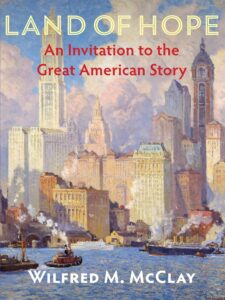
I think I first came across this author via the Imprimis newsletter, and Land of Hope came highly recommended. It is essentially a H.S./college-level history text (though a 2-volume “Young Reader’s Edition” came out in 2022 for 5th/6th-graders), beginning with the European settlement of North America and ending with “The World Since the Cold War”. From the Introduction:
“This book does not pretend to be a complete and definitive telling of [the American] story…. As will be clear, I have chosen to emphasize the political history of the United States at every turn, treating it as the skeleton of the story, its indispensable underlying structure. This emphasis is particularly appropriate for the education of American citizens living under a republican form of government. There are other ways of telling the story, and my own choice of emphasis should not be taken to imply that the other aspects of our history are not worth studying. On the contrary, they contain immense riches that historians have only begun to explore. But… one must begin at the beginning, with the most fundamental structures, before one can proceed to other topics.”
A Patriot’s History of the United States: From Columbus’s Great Discovery to the War on Terror (2004), by Larry Schweikart and Michael Allen
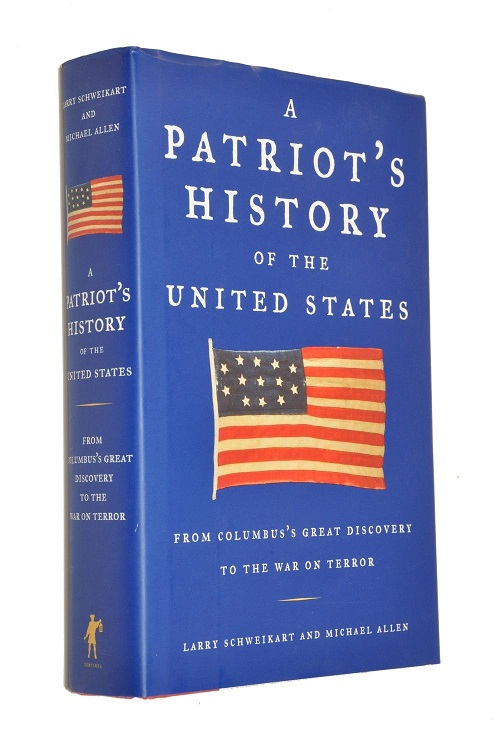
This book may be more familiar to some of you, as it has been out awhile longer than McClay’s work and has gotten some press. It covers roughly the same period as Land of Hope, but it is not a textbook, per se. Focusing on different controversial people, policies, and events, the authors “set out to correct the doctrinaire biases that had distorted the way America’s past is taught,” with Howard Zinn’s A People’s History of the United States being the prime example of such texts that distort and rewrite history to serve a negative agenda. From the Introduction:
“We remain convinced that if the story of America’s past is told fairly, the result cannot be anything but a deepened patriotism, a sense of awe at the obstacles overcome, the passion invested, the blood and tears spilled, and the nation that was built. An honest review of America’s past would note, among other observations, that the same Founders who owned slaves instituted numerous ways — political and intellectual — to ensure that slavery could not survive; … that time and again America’s leaders have willingly shared power with those who had none, whether they were citizens of territories, former slaves, or disenfranchised women. And we could go on.”
Note: A revised (and slightly expanded) edition of A Patriot’s History was published in 2014.
Note #2: This book could be paired with Mary Grabar’s Debunking Howard Zinn: Exposing the Fake History That Turned a Generation against America (2019).
The Heritage Guide to the Constitution (2005), by Edwin Meese III et al.
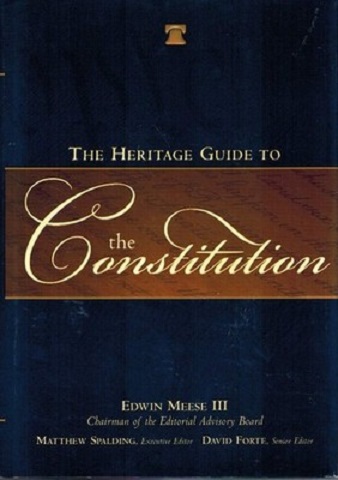
With ~100 attorneys and legal experts contributing, the purpose of the Heritage Guide is “not only to provide lawmakers and trained jurists with a reliable reference, but also to be explanatory, educational, and accessible to informed citizens and all students of the Constitution.” From the Preface:
“To create such a unique line-by-line analysis of our supreme law, we set about finding an expert to write on each clause identified in the Constitution, from the Preamble too the Twenty-seventh Amendment. Each contributor was asked to write a brief essay on a particular clause, with two objectives. First, provide a description of the original understanding of the clause, as far as it can be determined [from historical documents]. If within the standard of original understanding there are credible and differing interpretations, they were to be noted and explained. (The concept of ‘originalism’ is discussed in the introductory essay, ‘The Originalist Perspective.’) Second, the article was to provide an explanation of the current state of the law regarding the clause and, where appropriate, to give brief explanations of the historical development of current doctrine.
At the end of each essay, the authors have added cross-references to other clauses in the Constitution, suggestions for further research, and a listing of significant cases concerning that clause. (A complete index of cases referenced throughout the Guide is provided in Appendix A.)”
This is another book that has been around for several years now. I own a copy of the original, but there have been fully-revised second (2014) and third (2025) editions with many new essays. My plan is to eventually read through my current copy, then purchase a copy of the 3rd edition. I just hope I manage to do so before a fourth edition is warranted….
Bonus Resource: Know Thine Enemy: A History of the Left, Vol. 1 (2018) by Mark L. Melcher and Stephen R. Soukup
Note: As far as I know, a second volume has yet to be published.
There you have ’em. Reading through these three (or possibly five?) books, or at least referencing them from time to time, should make one a lot more grounded in solid American history and the U.S. Constitution. If you find yourself challenged with Zinn quotes or other Leftist claims about American history, the reasoning of the Founders, etc., these books will be great resources to have on hand.