Apr
19
Is Consciousness Really an Illusion?

Greg Koukl and his team at Stand to Reason (STR) put out a bimonthly newsletter titled “Solid Ground”, in which Koukl (or possibly a guest-writer) addresses some biblical, theological, philosophical, and/or socio-cultural issue. Lately, he has been doing a series called “Rapid Fire”, in which he gives brief responses to multiple such questions in each newsletter issue. I was reading the most recent one last month and saw a couple “vignettes” I thought would make particularly good blogposts here. So,…
In this first one, Koukl responds to the claim commonly heard from atheist-materialists that “consciousness is an illusion.” He does a fine job — with a surprising assist from atheist philosopher Thomas Nagel — of dismantling the argument for this claim, as exemplified by New Atheist Daniel Dennett, who as it turns out passed away exactly 2 years ago to this date (4/19/2026). Dennett’s “solution” to the consciousness “problem”, it seems, doesn’t really make all that much sense.
— — —
Consciousness is a serious problem for atheistic materialists.
Two concerns plague anyone whose worldview requires that every element of reality be reduced to something physical. One, consciousness is one of the most salient and undeniable features of reality. Two, consciousness is not something physical.
These two facts create such a difficulty for materialists that New York University philosopher — and committed atheist — Thomas Nagel stunned the establishment when he released his public lament on the dilemma. His book bears the scandalous [title] Mind and Cosmos: Why the Materialist Neo-Darwinian Conception of Nature Is Almost Certainly False.
Playing completely against type, Nagel argues that naturalistic approaches are utterly incapable of accounting for the central feature of human experience — human consciousness:
“Consciousness is the most conspicuous obstacle to a comprehensive naturalism that relies only on the resources of physical science…. If we take this problem seriously, and follow out its implications, it threatens to unravel the entire naturalistic world picture.”
Thomas Nagel is refreshingly candid about the conflict. Erstwhile New Atheist Daniel Dennett, though, was not so forthright. How does a dyed-in-the-wool atheistic materialist like Dennett deal with an obvious feature of reality that has no place in his worldview? He has only one refuge. He must deny that it’s real. Consciousness, he said, “is an illusion of the brain, for the brain, by the brain.”
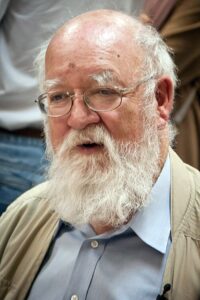
Dennett’s “solution” shows just how big of a bind materialists are in with consciousness. To make his physicalistic worldview work, Dennett must deny the reality of the most obvious feature of reality, our own self-awareness. His dismissal is surprisingly easy to dispatch since it’s self-refuting in an interesting way.
Often the first step in dealing with a challenge, though, is to get crystal clear on what is being claimed. Since consciousness is being dismissed as an illusion, we need clarity on what consciousness is and what an illusion is.
Your consciousness is your internal, first-person, subjective awareness of yourself and your mental states — your sensations, your thoughts, your beliefs, your desires, your intentions, and your acts of will (your volitions).
Notice two obvious features of consciousness. First, your conscious self is the thing you have more direct contact with than anything else in the world every waking moment of your life — and many of your sleeping moments, too. Simply put, consciousness is real — obviously.
Dennett’s first blunder, then, is dismissing the existence of something that’s unmistakably real to every other member of the human race. To save his foundering worldview, Dennett is forced to deny the most striking detail of human existence.
Second, consciousness is not physical, as Nagel grudgingly admits. The contents of our minds do not extend in space. They do not have weight. They are not beholden to the laws of physics and chemistry. Consciousness simply cannot be reduced to anything material.
Think next about exactly what an illusion is. It’s a false idea or belief or an experience of a deceptive appearance or a misleading impression. Simply put, illusions happen when a person’s conscious mind is being appeared to in a false way. They are errors of perception, conjured by your mind or fabricated by mistaken sensations distorted by your senses.
Forgive me for stating the obvious, but illusions themselves are conscious states. If consciousness is an illusion, then what is it that’s experiencing the illusion of consciousness? On Dennett’s view, our consciousness is perceiving the illusion of our consciousness. The illusion is having an illusion? Hardly.
Here is the critical question: How can consciousness be an illusion if consciousness is necessary to have an illusion to begin with? Things that lack consciousness (rocks come to mind) do not have illusions. Only conscious creatures can be “appeared to” falsely. If you cannot have an illusion unless you’re conscious, how can consciousness itself be an illusion?
Dennett’s second blunder — the self-refuting element — is beginning to become obvious. On his view, a purely physical thing that lacks real consciousness can possess a false idea or belief, or be aware of a deceptive appearance or a misleading impression, yet each of those is a feature of consciousness itself. Dennett’s dismissal of consciousness is self-defeating because he must presuppose what he’s trying to deny in order to deny it.
Consciousness is your direct, subjective experience of the contents of your own soul. Your soul is your irreducible, first-person self that is the possessor of all your mental activities — including whatever illusions and mental deceptions you may possess.
Daniel Dennett is mistaken, and Thomas Nagel is correct. Dismissing consciousness as mere illusion won’t do. Since consciousness is real, and the selves — the souls — that are conscious are real, too, the entire naturalistic picture of the world unravels.
— — —
Your ability to read and (hopefully) understand Koukl’s reasoning — whether or not you like or agree with it — reveals your consciousness at work. 🙂
I will reproduce a second “Rapid Fire” response from Koukl in a couple weeks…