Jul
5
What SCOTUS Got Wrong Re Birthright Citizenship
“Alito and Thomas argue that the Civil Rights Act of 1866 clearly shows that ‘subject to the jurisdiction thereof’ meant to exclude individuals “subject to any foreign power.” — Tyler O’Neil, Daily Signal
As you are likely aware, the Supreme Court of the United States recently voted on the matter of “birthright citizenship” in Trump v. Barbara (2026), striking down President Trump’s Executive Order 14160, which was an attempt to end birthright citizenship for children of parents without U.S. citizenship or permanent residency.
“In a 6–3 decision issued on June 30, 2026, the Supreme Court struck down the executive order, with Chief Justice John Roberts and Justices Sonia Sotomayor, Elena Kagan, Brett Kavanaugh, Amy Coney Barrett, and Ketanji Brown Jackson voting to invalidate it. The Court split 5–4 on the constitutional question, with Roberts writing that the Fourteenth Amendment guarantees birthright citizenship to everyone born on U.S. soil, joined by Sotomayor, Kagan, Barrett, and Jackson, while Kavanaugh concurred only on statutory grounds. Justices Clarence Thomas, Samuel Alito, and Neil Gorsuch dissented, arguing that the Fourteenth Amendment was not inconsistent with the executive order.” (Wikipedia)
This majority decision has been quite a disappointment for those of us who 1) see big problems with “birthright citizenship” and 2) had hoped that the more originalist-leaning S.C. justices (ostensibly including Roberts, Barrett, and Kavanaugh) would have been in agreement on this matter. President Trump, of course, was none too thrilled, either.

The dissenters, on the other hand, appear to be in agreement with Edward J. Erler, professor emeritus of political science at California State University, San Bernardino. Erler has served as a member of both the California Advisory Commission on Civil Rights (1988-2006) and the California Constitutional Revision Commission (1996). He has published numerous articles in legal journals and authored several books in his area of expertise (e.g., The United States in Crisis). Dr. Erler gave a speech on birthright citizenship published by Imprimis in 2008, and an updated version was published by Imprimis just a couple months ago. He demonstrates a clear understanding of the relevant historical context, Constitutional issues, etc., so I thought a couple citations would be helpful.
The first paragraph reproduced below is from the “Wong Kim Ark” section, which discusses a key court case in this debate. Then I backed up and quoted the entire “Who Is A Citizen?” section.
— — —
Contrary to claims made by defenders of birthright citizenship, there is no Supreme Court decision squarely holding that children of illegal aliens are automatically citizens of the U.S. In an 1898 decision, U.S. v. Wong Kim Ark, the Court did hold by a vote of six to two that a child of legal resident aliens is entitled to birthright citizenship. Even then, the Wong Kim Ark decision was based on the mistaken premise that the Fourteenth Amendment adopted the British common law system of birthright subjectship. The majority opinion did not explain how subjects were miraculously transformed into citizens within the supposedly adopted common law. Supreme Court Justice Horace Gray, writing the majority decision, merely stipulated that “citizen” and “subject” were convertible terms — as if there were no difference between feudal monarchy and republicanism! Indeed, Chief Justice Melville Fuller wrote a powerful dissent arguing that the idea of birthright subjectship had been repealed by the American Revolution and the principles of the Declaration of Independence….
Citizenship, of course, does not exist by nature. It is created by law, and the identification of citizens has always been considered an essential aspect of sovereignty. After all, the founders of a new nation are not born citizens of the new nation they create. Indeed, this is true of all citizens of a new nation: they are not born into it but rather become citizens by law.
Although the Constitution of 1787 mentioned citizens, it did not define citizenship. It was not until 1868, with the ratification of the Fourteenth Amendment, that a definition of citizenship entered the Constitution. Here is the familiar language: “All persons born or naturalized in the United States, and subject to the jurisdiction thereof, are citizens of the United States and of the State wherein they reside.” Thus there are two components to American citizenship: birth or naturalization in the U.S. and being subject to the jurisdiction of the U.S.
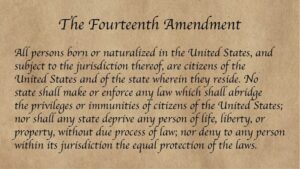
We have somehow come today to believe that anyone born within the geographical limits of the U.S. is automatically subject to its jurisdiction. But this renders the jurisdiction clause utterly superfluous and without force. If this had been the intention of the framers of the Fourteenth Amendment, they would simply have said that all persons born or naturalized in the U.S. are thereby citizens. Furthermore, the principal supporters of the Fourteenth Amendment were explicit about the meaning of “subject to the jurisdiction”: it meant owing exclusive allegiance to the U.S. and none to any other country.
It is broadly agreed by constitutional scholars that the purpose of the Fourteenth Amendment was to constitutionalize the Civil Rights Act of 1866, which was passed over the veto of then-President Andrew Johnson. A supermajority of both chambers of Congress approved the act, which established the citizenship of newly freed slaves and the protection of their rights and liberties on the exact same basis as white citizens. Many in Congress initially argued that the passage of the Thirteenth Amendment in 1865 granted citizenship and the rights and liberties attached to that status. Others argued that there should be explicit legislation, which resulted in the Civil Rights Act the following year. Still others thought the Civil Rights Act was insufficient because future majorities could repeal it. This concern became the impetus for the Fourteenth Amendment, which constitutionalized the Civil Rights Act.
The citizenship clause was a late addition to the Fourteenth Amendment. The first draft merely stated that citizens were “persons born in the U.S. or naturalized by the laws thereof.” This language was referred to the Joint Committee on Reconstruction, which reported back the language that became the citizenship clause. It is evident that the Joint Committee placed importance on the jurisdiction clause, which meant, at a minimum, that not all persons born in the U.S. were automatically citizens.
Michigan Senator Jacob Howard, who was the manager of the Fourteenth Amendment for the Reconstruction Committee, said the addition of the jurisdiction clause was “simply declaratory of what I regard as the law of the land already,” referring to the Civil Rights Act of 1866. Illinois Senator Lyman Trumbull, chairman of the Senate Judiciary Committee and principal architect of the Thirteenth Amendment and the Civil Rights Act of 1866, joined Howard in agreeing that the “law of the land” meant that “subject to the jurisdiction” connoted “complete jurisdiction” — in other words, not owing allegiance to anyone else.
Under Section 5 of the Fourteenth Amendment, Congress has the power to define “by appropriate legislation” who is subject to the jurisdiction of the U.S. Indeed, during debate over the amendment, Senator Howard, the author of the citizenship clause, attempted to assure skeptical colleagues that the new language was not intended to make citizens of the Indians. Although the Indians were born within the nation’s geographical limits, Howard steadfastly maintained that they were not subject to the nation’s jurisdiction because they owed allegiance to their tribes. Jurisdiction understood as allegiance, Howard pointed out, excluded not only Indians but “persons born in the United States who are foreigners, aliens, [or] who belong to the families of ambassadors or foreign ministers.” Thus “subject to the jurisdiction” does not simply mean, as is commonly thought today, subject to American laws or American courts. It means owing exclusive political allegiance to the U.S.

Consider as well that in 1868, the year the Fourteenth Amendment was ratified, Congress passed the Expatriation Act. This act permitted American citizens to renounce their allegiance and alienate, or abandon, their citizenship. Supported by Senator Howard and other leading architects of the Fourteenth Amendment, the Expatriation Act characterized the right of expatriation as “a natural and inherent right of all people, indispensable to the enjoyment of the rights of life, liberty, and the pursuit of happiness.”
Like the idea of citizenship, this right of expatriation is wholly incompatible with the British common law understanding of perpetual allegiance and subjectship. One member of the House of Representatives at the time expressed the general sense of the Congress when he proclaimed: “The old feudal doctrine stated by Blackstone and adopted as part of the common law of England . . . is not only at war with the theory of our institutions, but is equally at war with every principle of justice and of sound public law.” The common law established what was characterized as an “indefensible doctrine of indefeasible allegiance,” a feudal doctrine wholly at odds with republican government.
In sum, what we today call birthright citizenship is a legacy of feudalism that was decisively rejected as the ground of American citizenship by the Fourteenth Amendment and the Expatriation Act of 1868. It is absurd to believe that the Fourteenth Amendment confers the boon of American citizenship on the children of illegal aliens. Nor does the denial of birthright citizenship visit the sins of the parents on the children, as is often claimed, since the children of illegal aliens born in the U.S. are not being denied anything to which they have a right. A minor’s allegiance should follow that of his or her parents. Furthermore, it is difficult to fathom how those who defy American law can derive benefits for their children by their defiance — or that any sovereign nation would allow such a thing.
— — —
It seems to me that Justices Thomas, Alito, and Gorsuch were correct in their analysis and dissent, and the rest of the Court — if I may be so bold to suggest — need a refresher on the above. To read Erler’s article in full, please go here.
One last thing… Kurt Schlichter (U.S. Army colonel, Ret., and former L.A. trial lawyer), who also disagrees with the majority decision for Trump v. Barbara, reminds us of a few things. For example, the majority basically went along with the common legal understanding of the 14th Amendment for the past 150 years, and courts are loathe to change — let alone reverse — established precedent. So, this was always the most likely outcome.
Remember that Kavanaugh dissented from the majority on the constitutional issue (while agreeing on the statutory issue, i.e., Trump ), so on that count it was a narrower, 5-4 decision. Schlichter expected the Court to narrow their consideration only to the statutory matter, OR if they tackled the constitutional aspect, he thought there would be a 7-2 decision (Thomas and Alito dissenting). The fact that Gorsuch and Kavanaugh were willing to side with Thomas and Alito on the constitutional issue indicates at least some willingness to consider “new thinking on the 14th Amendment citizenship clause.”
As Schlichter points out, “we are one seat away from changing birthright citizenship.” This is a “huge” step forward!
