Jul
26
Why Does God Make Death the Deadline for Salvation?
I figured I was “due” to share something involving Christian theology or apologetics this week, but I didn’t have anything in the works and was growing short on time. Then I remembered Stand to Reason (STR) and the “Rapid Fire” series they did in their newsletter not long ago. If you’ve been reading along, you might remember that I shared three “Rapid Fire” vignettes — one each in April, May, and June — from Part 5, already. Why not squeeze one in for July?
This time, however, I went back to Part 3 in the series and grabbed the one that stood out to me the most, because I don’t think I have ever encountered this particular question/challenge. Also, Greg Koukl’s careful response was both “meaty” and succinct.
— — —
“Why does God make death the deadline for salvation? It seems arbitrary and even unfair to those who may die on their way to a church service where they intended to become a Christian.”
I’m including this rather unusual question because it offers a handful of different elements that are important to consider when responding to challenges.
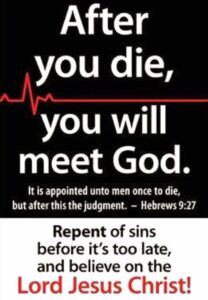
The first concern above has to do with the apparent arbitrary nature of God’s salvation “cutoff” point. The author of Hebrews writes, “It is appointed for men to die once and after this comes judgment” (Heb. 9:27). But why then? Why not sometime later? Why any cutoff point at all? It makes little sense to some critics.
The second concern is more weighty. What if someone gets killed on his way to church where he intended to respond to an altar call to become a Christian? Since death is the point of no return for salvation, then a circumstance this person had no control over deprived him of eternal life. Worse, what if murder was the cause of the death that interrupted the trip? Wouldn’t it be odd if a felon’s crime were the reason his victim was damned to Hell forever?
Implicit in this challenge is a subtle insinuation. Christianity is just too strange, bizarre, or unfair to be taken seriously.
Is Christianity significantly undermined by an inability to divine God’s reasons for a salvation cutoff point? The answer is “no” for a number of reasons — the death-on-the-way-to-the-altar-call concern notwithstanding.
First, I have no reason to think God is arbitrary about anything. Why assume he’s arbitrary just because in some cases we don’t know why he does what he does? It suggests a defect in the Divine when there’s no good reason to think so.
I’ve often pointed out that questions starting with the phrases like “Why did God…” or “Why didn’t God…” are frequently impossible to answer for good reason: God hasn’t told us. If God is mute on some issues, then we’re simply in the dark. Unless God gives us his reasons, we can speculate all we want. Some of those speculations may have merit, but they will have no authority. Speculations remain speculative.
Second, what if I simply responded, “I don’t know why God set death as the deadline”? What harm would befall the case for Christianity then? None, as far as I can tell. All the evidence in favor of Jesus’ life, death, and resurrection would still be intact as well as all the various lines of evidence for God’s existence.
Here’s the basic principle: Our inability to answer hypothetical questions about God’s intentions has no bearing on the truth of the Christian worldview. Full stop. Lack of concrete answers to these kinds of queries signifies nothing.

Third, it’s not clear that any answer to the first question would satisfy a critic. If God had decided on a different “point of no return” for salvation, would that make any difference to the challenger? No matter where God drew the line, it seems, the same question could always be raised, so suggesting alternate cutoff criteria gets you nowhere.
Fourth, some speculations may be useful — though not definitive — if they suggest reasonable possibilities. For example, it makes sense to me that death ends any opportunity for forgiveness because when a person dies, it ends the lifetime of sin for which he will be judged. A criminal’s life of crime comes to an end when he’s caught. If he had eluded capture, he might have changed course and possibly eluded justice as well. When he’s brought before the judge, though, it’s too late. His career of crime is over and “after this comes judgment.” Nothing odd about that.
What about the darker concern, though, that circumstances outside the control of a would-be penitent might seal his fate forever? My answer is twofold.
First — in my view at least — anyone planning to become a Christian at the next church altar call is probably already a believer simply waiting for an opportunity to formalize his faith publicly. Interrupting his trip to church changes nothing about his eternal destiny.
Second, any critique of Christianity must take the whole of Christian doctrine into account, or the critic will be tilting at windmills.[7] Human freedom has its limits, otherwise God would not be God — not the Christian God, at least, and that’s the God in question. Even a murderer’s free will doesn’t ultimately determine the course of the universe. God has his purposes, too, and he accomplishes them in spite of the sinful choices of evil people. Any hypothetical circumstance that presumes human actions alone decisively determine human destiny ignores a cardinal principle of the Christian creed: God is sovereign.
When all is said and done, keep in mind that there are imponderables in every worldview. We shouldn’t be surprised if some turn up in ours.
[7] Failure to do this is called a “straw man” fallacy.
— — —
It would be interesting to see/hear how other Christian apologists might respond to this question. I’m guessing there would be a lot of overlap, at least among the more thoughtful and fairly educated ones. Regardless, Koukl did not disappoint.
