Oct
18
Why We Should NOT Eliminate or Pack the U.S. Supreme Court

Last week, I posted “Why Leftists Want to Eliminate or Pack the U.S. Supreme Court”, based upon a speech given by law professor/author/commentator Jonathan Turley a few weeks back. In this sequel post, I have continued to cite portions of the article adaptation, presenting Turley’s discussion of the function of the U.S. Supreme Court and how it works to the benefit of the American citizen. Even those of us who favor the Supreme Court’s current structure and intended function can appreciate this brief review…
— — —
A non-partisan, independent judiciary serves two essential purposes: it plays a vital role in preserving the separation of powers, which prevents all government power from being concentrated in one place, and it stands as a bulwark in defense of minority rights against a majority faction. To ensure its ability to perform these essential roles without being threatened by the political branches — the Congress and the executive branch — the Constitution gives federal jurists life tenure and salary protections.
Despite these structural protections, early in our nation’s history there were few professional standards governing the American court system. Courts were openly biased…. Judges and justices routinely ran for political office and openly engaged in political commentary from the bench. But this would change….
Even today, regardless of the charges hurled against the Supreme Court by both the Right and the Left, what critics call partisanship is actually deep and good-faith jurisprudential differences on both ends of the Court. This was also the case when, for a period of many decades, the Court had a liberal majority. And during that period — even during the years of the Warren Court in the 1950s and ’60s, when conservative precedents were overturned in large numbers and conservatives were often outraged — there were virtually no calls to pack or eliminate the Court….
In reality, the attack on the Court as partisan is entirely disconnected from its actual voting record. It is a too-little-known fact that 44 percent of cases that come before the Supreme Court are decided unanimously. When you include nearly unanimous cases — those decided by 8–1 and 7–2 margins — that figure jumps to over 60 percent. It is also common for liberal and conservative justices to vote with colleagues on the opposite end of the ideological spectrum. In a case this year, for example, conservative Justices Thomas, Alito, and Kavanaugh joined liberal Justices Sotomayor and Jackson in the majority decision, while liberal Justice Kagan joined Chief Justice Roberts and Justice Barrett in the dissent.
Liberal justices from Stephen Breyer to Elena Kagan have refuted claims that today’s Court is a partisan institution. Justice Kagan, as reported in Politico, spoke recently on this topic and “reject[ed] claims that the high court’s conservative majority is in President Donald Trump’s corner.” The fact is that the ongoing enthusiasm for packing or eliminating the Supreme Court is based less on the voting records and views of the justices than on the idea, as Senator Warren put it, that the Court should follow what she perceives as “widely held public opinion.”
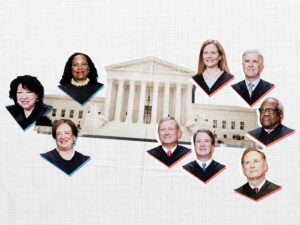
For those on both ends of the political spectrum, judicial restraints on their favored policies can be frustrating or even infuriating. And sometimes, as history shows, the Court can get things wrong. On the other hand, those restraints often represent a firewall for natural rights.
Consider the attacks on free speech that came to a head during the Biden administration, when a coalition of forces in government, academia, and corporations created the largest censorship system in the history of our country. Free speech as guaranteed in the First Amendment has been understood throughout our history, almost universally among Americans, as a bedrock principle essential to all our rights. Yet there was an aggressive campaign between 2020 and 2024 to curtail free speech on the Internet and elsewhere by labeling it “disinformation,” “misinformation,” “malinformation,” or “hate speech.” Those standing in defense of free speech were dismissed, in the words of one law professor’s book, as members of a “cult of the Constitution.” This campaign followed a trend in Europe, where speech is increasingly criminalized. But European laws never understood free speech as a natural right, and Europe’s courts have never aggressively protected it.
Here in the U.S., on the other hand, one of the greatest triumphs for free speech came in the Supreme Court’s 2023 decision in 303 Creative LLC v. Elenis, which held that Lorie Smith, a Christian website designer, could refuse to provide services for a same-sex marriage. Justice Gorsuch, writing for the majority, argued that “the framers designed the Free Speech Clause of the First Amendment to protect the ‘freedom to think as you will and to speak as you think.’ … They did so because they saw the freedom of speech ‘both as an end and as a means’ … an end because the freedom to think and speak is among our inalienable human rights.”
Had 303 Creative been decided in a different way, states and cities could compel or curtail speech according to whatever their leaders viewed as discriminatory elements under public accommodations laws. Instead, the Court adopted a bright-line rule that business owners could decline to create expressive products from cakes to websites. The counter-majoritarian function of the Court worked in the 303 Creative decision to protect natural rights. Regardless of whether it reflected the will of the Colorado majority, it upheld the right of free speech….
Ironically, those establishment figures trying to cancel the Court today are delusional in not foreseeing that they will be undermining their own freedom and security should they succeed….
The history of canceling courts is a history replete with unhappy endings. Courts are by necessity one of the first targets of revolutionaries…. In revolution after revolution, newly-established courts carried out the purported will of the people with terrible consequences. In an age of rage, it is too often reason itself that is canceled.
— — —
Makes sense to me. SCOTUS protects people’s natural rights, even against the majority. You might not like it when the decision goes against your personal preferences, but you will appreciate it when the tables are turned.
(Source Imprimis article.)
