May
31
The Lost Art of Diplomacy
“Excellence in diplomacy is a vital prerequisite to the success and endurance of great powers…. [T]he United States will need to recover the lost art of diplomacy.” — A. Wess Mitchell, “Recovering the Lost Art of Diplomacy”
It is time to take a look at another great article via Hillsdale’s Imprimis newsletter. This one was adapted from a speech delivered last October by A. Wess Mitchell.

If (like me) you are unfamiliar with the name, Mitchell (who has a D. Phil) “is a principal and co-founder at The Marathon Initiative, a grand strategy think tank. From 2017 to 2019, he served as Assistant Secretary of State for European and Eurasian Affairs.” He is also “recipient of a Stanton Foundation prize for writing in applied history” and has authored/co-authored several books in his areas of expertise, including Great Power Diplomacy.
The main points of the article in question, from which I have extracted a few excerpts below, is understanding what proper diplomacy entails, examining its use and misuse in history, its importance in dealing with current international issues, and a few ideas on how the U.S. is and can continue to recover this “lost art”.
— — —
[B]y diplomacy, I don’t mean John Kerry landing in Davos, Switzerland to give a lecture to the world’s political and business leaders about climate change. I mean the use of negotiations to reconcile conflicting interests on matters of war and peace…. I should also define what I mean by strategy: it is the matching of national means, in the form of military and economic resources, to national ends, in the form of foreign threats and opportunities. Danger arises when gaps emerge between the means at a nation’s disposal and the ends to which those means must be applied….
There are two erroneous conceptions of diplomacy that have become entrenched in the modern mind, one mostly on the left and the other mostly on the right. The main error on the left is thinking that diplomacy’s purpose is to build rule-making institutions that transcend nation-states and that will eventually expunge war from the human experience. A historical example of this is seen in the policies of President Woodrow Wilson after the First World War, as in his promotion of a League of Nations. This way of thinking persists today in the liberal institutionalism of those who advocate for a rules-based international order. [More on this last idea later.]
The main error on the right is thinking that human societies can only find true safety and honor in a preponderance of military power, and that diplomacy is more often than not a form of surrender. This view finds expression in the perennial accusations of appeasement or comparisons to Neville Chamberlain and the Munich Agreement of 1938 — when the British Prime Minister agreed to Nazi Germany’s annexation of the Sudetenland as a means of preventing war — anytime an American president engages in direct diplomacy with a U.S. adversary….
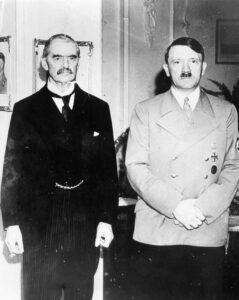
In 1938, Chamberlain needlessly squandered the opportunity to amplify the natural constraints on Germany that traditional British diplomacy would have accentuated — including especially the fear among Germany’s neighbors of its growing strength and the opportunity that this created for Britain to pursue its age-old policy of coalitions. Rather than constraining German power, Chamberlain’s diplomacy removed constraints.
The situation of the U.S. today is not so different from other great powers throughout history. We face a rising peer in China, a resurgent Russia, plus Iran, North Korea, and numerous smaller opponents like the Houthis. As two consecutive National Defense Strategies have made clear, our military is not postured or equipped to fight all of these opponents simultaneously. That’s unlikely to change any time soon. America has a $30 trillion debt. We now spend as much on annual interest payments on that debt as we do on our defense budget.
These are classic conditions for the use of strategic diplomacy. The immediate goal should be to avoid a war on multiple fronts potentially beyond our ability to win — to avoid it entirely if possible and to ensure that if it does eventually come, we are in a better position to wage it than we are now. And to that end, we should buy time to create conditions abroad that support a rigorous program of national rejuvenation at home.
The running focus of U.S. diplomacy should be to ensure favorable balances of power in the world’s major regions: Europe, the Middle East, and the Far East. Our diplomacy needs to foster a sufficient degree of indigenous stability in the first two of these regions through the skillful use of coalitions, such that we are able to concentrate greater U.S. military effort against the main threat, which is China.
Re-embracing a ‘balance of power’ logic will require changing how the U.S. has approached foreign policy for the past generation. The biggest change is a recognition of limits. “The nature of things in this world,” as the 16th century Italian diplomat Francesco Guicciardini wrote, “is such that nearly everything contains some imperfections in all its parts.” American foreign policy has been proceeding from the opposite impulse: a kind of grand meliorism that aspires to the loftiest imaginable goal of remaking the world in our image. Effective diplomacy, by contrast, starts from the much more grounded and conservative recognition that national resources and national will are precious and finite, and that the chief duty of leaders is to use them shrewdly and sparingly on the attainable ends that matter most.
An acceptance of limits goes hand in hand with an emphasis on diplomacy’s main role in strategy, which is to place constraints on the accumulation of hostile power. There is a modern fallacy that diplomacy’s job is to uncover good intentions on the part of an adversary or to remove the obstacles to supposedly natural patterns of peaceful cooperation. It was that way of thinking that led the U.S., after the Cold War ended, to actively assist China’s economic rise — based on the faulty assumption that a more prosperous China would be a friendlier China. The effects of that policy bedevil the U.S. to this day. Classical diplomacy is altogether more pessimistic about human nature. As in the parable of the unjust steward, we have to be shrewd in the ways of this world in order to preserve what is good.
Diplomacy is not surrender, and talking to an opponent is not a reward for good behavior. In dealings with China, Russia, or Iran, U.S. diplomatic initiatives must always be measured not by the process or optics — or by whether they support an abstract goal — but by whether the outcome results in greater or weaker constraints on a rival’s ability to harm us and our interests….
There is a mantra in establishment circles about maintaining the “rules-based international order.” But “international order” is not an intrinsic good — indeed, it can be deleterious to America if it involves rules or commitments that undermine our national welfare or safety. Effective diplomacy always has the national interest as its chief objective….
— — —
In the parts that I didn’t cite, Mitchell writes about more historical examples early on, and later about the importance of allies and of “build[ing] institutions at home that support excellence in the practice of diplomacy.” (There is some overlap with a post I put out in early 2024 titled “A Plan for Fixing the CIA”.)
As usual, I recommend reading the full article by Mitchell.